The Lasting Legacy of Rich Boy’s “Throw Some D’s”
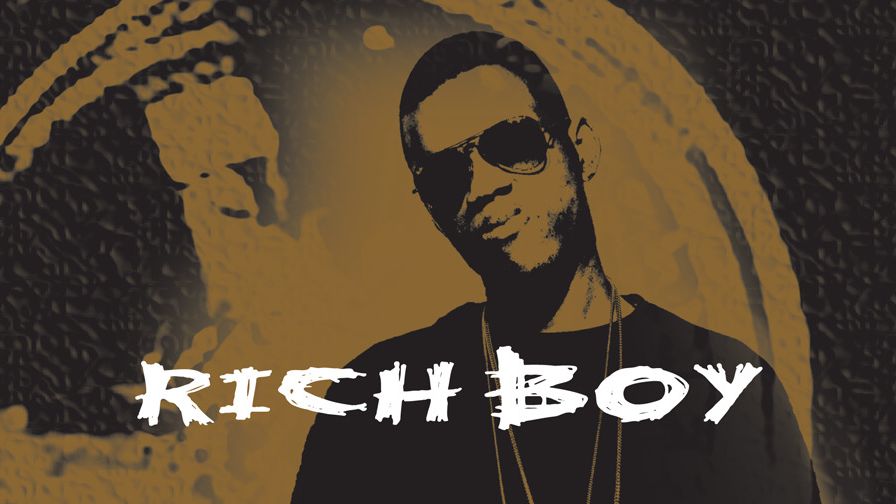
When Polow da Don isolated those three bittersweet chords, pedaling between major and minor, he must’ve known. Those chords—taken from the extended intro to the 1979 smooth-soul jam “I Call Your Name,” by the Ohio-based band Switch—suggested both dawning joy and nagging worry, forward motion and hesitation. They don’t just move; they glide. They suggest dramatic entrances, receding horizons. They hint that something glorious might be over the next rise.
He looped those three chords into four bars, inserting another hiccuping little loop in the middle. The result was a bottled hit of giddy anticipation: The beat to “Throw Some D’s” swoons grandly into view, then does so again, then does so again. Every time that third stair-step chord hits, new vistas open up, and we eagerly scan our environment for new information. During its four minutes, “Throw Some D’s” climbs that little three-chord staircase roughly 18 times, and Polow sends new sonic cartoon characters scurrying across the frame with each repetition.
He fades the chords, so they arrive to us from somewhere tinnier and further off. He unleashes the massive 808s. He cuts the beat entirely when Rich Boy’s blaring voice enters. He buries a five-hit tom roll near the ocean floor of the mix, where you reliably sense its presence but never notice it.
He can’t leave those three glorious chords alone. He throws slowing-vinyl effects on them; he decorates them with six different tracks of beeping keyboards, draped across the beat like tinsel. Every millisecond of the track is imprinted with an effect, and yet the mix has miles of space. It’s possible that no rap song is as full of detail and incident as “Throw Some D’s.”
And then there’s Rich Boy, who drops into the song with the same funhouse trap-door energy as all the effects, blaring his opening line: “RICH BOY SELLING CRACK.”
Rich Boy owed his entire rap career to Polow da Don. The two first crossed paths in 2001, when Rich Boy was Maurice Richards, a soon-to-be dropout at Tuskegee University, studying mechanical engineering. He was also an aspiring rap producer, and although Polow graciously accepted Richards’ beat CD, he also encouraged Richards to switch to rapping. In the late ’90s, Polow released two solid, heavily Goodie Mob-indebted records as part of the Atlanta rap trio Jim Crow before they lost their deal, and maybe he heard something of that group’s funk and darkness in Richards’ voice.
The two stayed close over the next few years. Richards took Polow’s advice, releasing a DJ Drama mixtape and popping up on Ludacris compilation cuts, and Polow pushed to the center of the pop-rap world, producing party tracks for radio-friendly artists like Jamie Foxx, Will Smith, Ludacris, and the Black-Eyed Peas. Polow and Rich Boy seemed to share something deep: a tension, a connection, an understanding of how they wanted music to sound and feel. Both of them needed the other to unlock their latent promise.
A Pivot Point for Rap Production
On “Throw Some D’s,” Rich Boy is inside the beat, entirely of the beat, in a way that few rappers ever manage to be. Just like the beat, he seems to be reintroducing himself with every bar. You can never predict precisely where his next syllable will land. He raps two 12-bar verses, four short of your typical 16-bar finish line, and yet his perpetual-motion flow makes each feel longer and denser. He doesn’t rap behind the beat so much as dangles off the back of it, leaning hard on the spoilers of Polow’s Mario Kart to ensure it won’t leave earth.
”Throw Some D’s” only hit No. 6 on the pop charts, but its reverberations ran so deep that every one of rap’s imperial figures responded to it. Kanye West, in the throes of recording Graduation, took time out from his 66th or so mixdown of “Stronger” to rap over Polow’s beat. “Throw Some D’s” made its way into the groundwater of his new album, from the tinsel-bright keys of “Champion” and “Good Life” to his pitch-shifted chants of “MORE ASS THAN THE MODELS.” Lil Wayne, at the apex of his mixtape run, offered his own take on Da Drought 3, and even the reticent André 3000 dusted off his mic.
What André, Kanye, and Wayne all heard in “Throw Some D’s,” although they didn’t know it yet, was the next 10 years of rap production, gestating and dividing cells. “Throw Some D’s” is the pivot point for mid-2000s rap. You can hear six or seven years of Timbaland and the Neptunes in the rearview, as well as the faded sheen of Def Jam’s early-’00s soul-sampling. But it’s candy-coated, busy, and cartoonish in a way that points directly to figures like Atlanta’s Zaytoven, whose era-defining work with Gucci Mane and Migos was still a few years away. You don’t get to Young Chop, whose beats for drill pioneers like Chief Keef embraced a similar ProTools-gone-mad aesthetic, without “Throw Some D’s. “Throw Some D’s” felt like it was exploding and atomizing in your headphones, and a generation of producers heard the clunk of a gauntlet. I’ve often thought that the Scooby-Doo bongo run sound that Metro Boomin used to tag beats like “Karate Chop” was an echo, conscious or otherwise, of Polow’s subliminal tom roll on “Throw Some D’s.”
Somehow, “Throw Some D’s” was the end of Polow and Rich Boy’s collaborative story, not the beginning. The single failed to lift Rich Boy’s excellent self-titled 2007 debut album above gold status, and Rich Boy spent the next six years sinking into Interscope’s tarpit, recording songs that went nowhere, until he was released from his contract. When his name resurfaced in the news, about eight years later, it did so unhappily. He has become a “what happened to…?” conversational figure, instead of a stylistic touchpoint.
The Lasting Influence of Flow
But his flow patterning has influenced generations of new rappers. When GloRilla broke through in 2022, I heard a childhood spent listening to Rich Boy in the way she entered the beat: She wipes her feet on it, seeming to slow down a song’s BPMs with her drawl alone. Swae Lee and Slim Jxmmi, the brothers who formed Rae Sremmurd, melted their voices into the surroundings in an unmistakably Rich Boy way.
Polow da Don, meanwhile, went on to have a brief run at the epicenter of pop, becoming the kind of producer who takes everyone’s call. He put his name on a lot of enduring songs that wound up in clubs and gyms—“London Bridge” and “Glamorous” by Fergie, “Buttons” by the Pussycat Dolls, “Anaconda” by Nicki Minaj—but he never once made anything as indelible, as eternal, as this. He surely knew it, which is maybe why, on his own verse on the song, he embeds a bit of personal history, where no one but an incredibly select few will find it. The opening couplet “I never slip, I never fall/A lotta hoes give me they number but I never call” comes, verbatim, from a Jim Crow song called “Can We Do This.” An acknowledgement of how far he’d come, maybe, the equivalent of scratching “POLOW WAS HERE” on the one thing he made he was sure would last.