Out in Bangkok With Thaiboy Digital
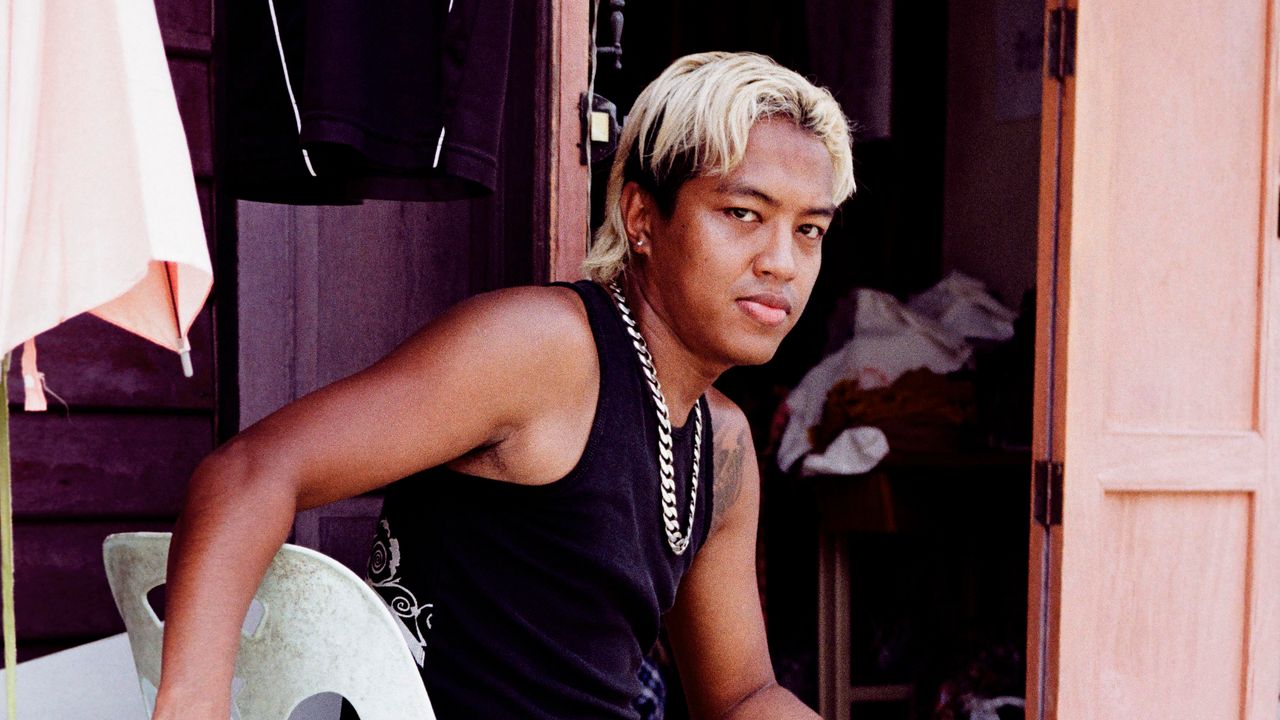
The cult status Drain Gang commands online has created an inscrutable, near-mythical air around its members. So I’m surprised that when I meet one of the crew’s leaders, Thaiboy Digital, he looks exactly like I was expecting, dressed in his signature preppy Swedish style with a splash of designer: red Ralph Lauren polo, blue Evisu jeans, and bright yellow Christian Louboutin sneakers, the ones covered in studs. We’re in Thonglor, an upscale neighborhood in Bangkok, but the way he talks about it, it might as well be his hometown of Stockholm, minus the weather. His friends Bladee and Yung Lean were just here, and he recently saw producer Gud whiz past on a bike without knowing he was in town.
I’m sitting across from him at a table at The Commons, a multi-story complex of trendy food stalls and bars with a sprawling outdoor seating area in the shade, dotted with greenery and fans to combat the sweltering heat. A playlist of inoffensive music wafts out the speakers, and at a specialty coffee shop, Thaiboy orders the house blend from Chiang Rai. I follow his lead.
A New Chapter in Bangkok
Thanapat Bunleang—Nino to his friends—was born in Sweden. But once his mother’s work visa expired and he turned 18, he was not granted permanent residence, leading to his official deportation in 2015. Now, Bangkok is where Thaiboy Digital calls home. And despite being 5,000 miles away from the Drain Gang hub, he has remained active, releasing three full-length solo projects and multiple EPs and loosies. Lately, he’s been moonlighting as DJ Billybool, his Swedish-language Eurodance project, which has become an incubator for some of the most inspired and personal work of his career.
“I was so lost,” Thaiboy says, looking back on those first years in the city after his deportation. “I don’t think I valued my life in the way I do now with my family. Everything had been taken away from me, so why should I care?” It was a time of heavy partying, missing home, and hanging around the wrong crowd. “It was trapped out,” he adds. “Whenever the guys were here, it was dope. We’d record, and it was productive, but as soon as they’d leave, it was back in the trenches.”
Once Thaiboy began experiencing high-energy Thai party music on sweaty dancefloors, it rekindled his love for dance music and sparked connections between his Thai and Swedish upbringing, leading to his dark and trancey new EDM album Paradise, out in May. “Other than all the lessons I learned, it was the music that I took from my dark ages,” he says.
Domestic Bliss and Musical Roots
Thaiboy remembers his last days in Sweden marked by the steady rise of the Swedish Democrats, a party with neo-Nazi roots that made strides in the 2014 elections. Today, they are the second largest party in the country, and stories of deportations similar to Thaiboy’s make headlines daily. “I know that feeling,” he says. “It takes a while to bounce back. It’s not something you do by yourself either.”
These days, his life in Thailand resembles domestic bliss. He posts videos cooking with his daughters and grinning selfies with his wife. On the streets of London, Paris, and Stockholm, he’s recognized regularly, but here in Bangkok, he estimates it’s once a month, if that. “I’m an anonymous person here,” he says. “The double life is a good life hack!” He’s embraced being a regular guy, rarely doing interviews. And although he seems at ease as we switch between Swedish and English, his crisp Stockholm accent is colored by slight trepidation, perhaps warming to a language he doesn’t use daily anymore.
As a teenager in Stockholm, Thaiboy began making music alongside Bladee, Ecco2k, and producer Whitearmor, whom he met through mutual friends during summer nights out, drinking vodka and listening to music. They started a 10-person collective called Smög Boys, which splintered into four and became Gravity Boys before finally landing on Drain Gang. Initially, like their friend and collaborator Yung Lean, they were considered a curio, rapping in broken English over cold, vaporwave synths. But 10 years on, it’s hard to imagine a group more revered by the underground rap and hyperpop scenes.
Of the trio, you listen to Thaiboy for his unfussy cool. He’s a slyly skilled rapper; check out “Kit Kat” off his 2019 album, Legendary Member, where he swerves in and out of flows and pockets like a bike in Bangkok traffic. His signature move is turning a repetitive hook into a mantra. On his explosive 2022 single, “I’m Fresh,” he repeats the phrase over 50 times in a minute and a half. Run it back a couple times and you won’t dare question his or your own freshness ever again.
The Sound of Paradise
He just got back from Koh Samui, the island in the Gulf of Thailand you might recognize as the setting of the third season of White Lotus, where he was shooting the album cover for his upcoming album, Paradise. The record takes its cues from his recent dance explorations as DJ Billybool—similar to how Yung Lean’s latest guitar-driven album, Jonatan, felt indebted to his troubadour side project, Jonatan Leandoer96.
On it, Thaiboy makes a brave proposition: Take early Swedish House Mafia with a straight face, then look past the glow sticks and confetti to locate the euphoria and melancholy that underlie the minor-key synths and endlessly revving build-ups. Building on last year’s DJ Billybool album DYR, it feels like a peek into Thaiboy’s musical lineage. DYR began this journey by mixing early ’00s Eurodance with the bass-heavy Swedish genre EPA-dunk and 3Cha—the giddy electronic dance music from Thaiboy’s home region of Isaan in Thailand—to form a new kind of globalist hyperpop.
Singing in Swedish for the first time on DYR allowed him to shed a layer of skin and get closer to verbalizing his feelings. “I’m not Swedish, but all my friends are Swedish and I grew up there, so the Swedish language hits differently in the heart,” he says.
In the past few years, members of Drain Gang have also found inspiration in their Swedish roots. “Blomstertid,” off DYR, feels like the most personal homage to Thaiboy’s teenage years, sampling Sweden’s most famous summertime hymn “Den Blomstertid Nu Kommer” while the lurid video mixes pagan imagery with the fjortis subculture popular in Swedish high schools of the ’00s. “The fjortis era? It was the best time,” Thaiboy says.
We resort to Swedish to unpack the bizarre fashion trends of the era—skin-tight V-necks and hair embalmed in wax, orange foundation and backcombed platinum blonde hair, G-Star and Evisu jeans. An unholy mixture of Pauly from Jersey Shore and Millie B of “M to the B” fame. The soundtrack of fjortisar was Basshunter, Thaiboy’s favorite Swedish artist of all time, whose Eurodance classics “Boten Anna” (a song about falling in love with a chatroom bot) and “DotA” (a song about online gaming) became early viral hits that crossed over to radio and introduced the wider Swedish public to a generation growing up online. (You might know these songs by their English remakes “Now You’re Gone” and “All I Ever Wanted.”) “He was the founder of that fjortis style, type shit,” Thaiboy says of Basshunter. “We did the things he did in his songs. I was at [the gaming center] Inferno Online playing DotA. We were gamers, we partied, he spoke to us.”
Another strain of Thaiboy’s dance music DNA is 3Cha, the Thai party music often blasted at street parties during Songkran, the Thai New Year. The genre shares similarities with Eurodance’s ditsy melodies, but it also taps into a kind of kitsch found in both Swedish and Thai cultures, like their shared love of schlager, a type of schmaltzy pop. Re-discovering 3Cha as an adult was a revelation for Thaiboy, rekindling his love for dance music: “I found the way of 3Cha in the parties,” he says. “It goes to my core. I fully lived the life with this 3Cha party music to an extent few people understand. It reaches for the stars, and I was Neil Armstrong in the club.”
“When we go to afterparties in Europe, I feel like it’s lacking,” he continues. “We’re not on the moon. What are we doing?” His “Nino Lifestyle 3Cha Mix” is a full-throttle introduction to the genre, and he’s currently working on an English language 3Cha-inspired project with Whitearmor.
“At this age you start thinking about your roots, where you come from. At this point in life, people either become nostalgic for the rest of their lives, or they go, This is where it started, now let’s move on,” he says. With Paradise, the plan was to push further into the history of Swedish dance music with his core producers, including fellow Swedes Eurohead and Varg along with the Aussie Jamesjamesjames, recording together as SWEDM while bunkered up in Phuket last summer. “This should be for the world, not just Swedish people,” he says. “Let’s take it further.”
The sound of Paradise shifts the frame of reference by a few years, channeling the period after Eurodance in the early 2010s, when EDM was associated with a strain of euphoric, progressive house, before it became a meme characterized by bombastic drops and popstar collabs. Or, as Thaiboy explains it, “Everything before David Guetta’s time.”
Paradise is all interlocking supersaws, stabs of trancey synths, wobbles of acid house, and deep 808s, kitted out with muscular kick drums that feel like the sleek inside of a G6 en route to Ibiza. “It’s all engines go,” he says. “I want it to be heavy, I want it to ground you to the floor.” While the song “Dreaming Your Reality” suspends us in euphoric build-up for three shimmering minutes, songs like “Zatoichi” and “Christian Louboutin” go full-tilt with pummeling hard-trance kicks you feel in your gut.
This expensive sound sets the scene for the Thaiboy-isms of “Euro Dollar Yen” (repeated until you hear “you know who I am”), and the jet-setting “Silk Road,” where he rhymes “Thonglor” with “Christian Dior.” But these flexes are buoyed by wistful introspection. On “Irish Tears,” the album’s centerpiece, Bladee asks, “Is this life as life goes by?” And “Surrendering to the Rhythm” is a slice of pure rave nostalgia, the fist-pumping intro fading to give way to a somber piano melody. “My life’s been so crazy, baby I’m a rollercoaster,” he croons.
It feels like the culmination of a lifetime of musical experiences—as a reformed fjortis, as a member of the hottest internet rap group, as a partygoing twenty-something resetting his life in Bangkok. “All of that had to happen so that I could make Paradise,” he says. As we talk, his wife and youngest daughter join us at the table along with Ecco2k, whom they ran into earlier. Thaiboy might still be defined by his double life, split between cult-favorite internet rapper and family man, but it all seems to come together here in Bangkok. “I’m still wearing fjortis style to this day,” he says, showing off his polo and Evisu—100-degree weather be damned.