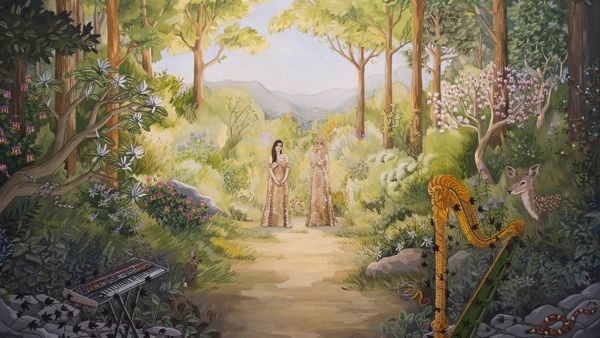
Julianna Barwick and Mary Lattimore have enough in common that it’d be weird if they hadn’t worked together. Both grew up in the South and found early inspiration in spiritually rooted musical forms that they could transform with technology. For Lattimore, that meant intensive training on the harp, the instrument of gods and angels, which her mother introduced to her at home in the hills of western North Carolina. Barwick’s path led from a fascination with voices reverberating in a church’s sanctuary to the discovery of loop pedals and then on to lo-fi records crafted after a move to Brooklyn. Since 2019, they’ve collaborated on various songs and occasionally shared the stage. In 2025, France’s Musée de la Musique, which houses thousands of historically significant artifacts, invited them to Paris to record an album using some of the museum’s instruments. Tragic Magic, assembled from recordings made over a period of nine days, is the culmination of the project.
The opening “Perpetual Adoration” sounds almost exactly like you’d expect it to when imagining Barwick’s voice and Lattimore’s harp in the same space—which makes it enjoyable but never quite transcendent. It’s unhurried and dreamy, with slow, ringing notes and the singer carefully articulating a single reverb-drenched syllable at a time. For all its obvious beauty, it’s just a little dull, because it never surprises. Each of us has an internal meter that quivers when excessive sweetness tips over into something we’d describe as “saccharine”; for some, “Perpetual Adoration” may inch up to the line of too-muchness.
But this issue, if you hear it as one, doesn’t crop up again, and Tragic Magic grows more involving with each track. When two artists this distinctive and identifiable come together, you want to hear them make a third thing that wouldn’t exist without the collaboration, and the progression of the record finds them steadily feeling out that place. “The Four Sleeping Princesses” starts with a minimalistic pattern from Lattimore before Barwick adds synth and multi-tracked voice. Unlike “Perpetual Adoration,” there’s movement and evolution—it’s about accretion, a clear, defined and orderly structure gradually acquiring density, and in its final section a mass of voices is sloshing around unpredictably. On “Temple of the Winds,” a brief piece sketched for the pair by composer Roger Eno, Lattimore’s tone is sharp and pointillist, each carefully articulated note a pinprick, while Barwick works against the edges, her eerie melody assuming a drifting and gaseous form.
A cover of Vangelis’ “Rachel’s Song,” from Blade Runner, is an inspired choice (they’ve previously performed it live). The original is a clear precursor to Barwick’s style, and she uses her voice in a way that’s unusual for her, with a rounded tone that evokes the place where Vangelis’ Far East exoticism meets the dusty plain of Ennio Morricone. Just as thrilling is “Stardust,” which leaves the baroque trappings behind so the duo can indulge in time-tripping kosmische. It combines a buzzing analog synth fit for a planetarium laser show with Lattimore playing triple-time phrases, all while Barwick’s voice is rendered alien through processing. “Stardust” lasts for seven minutes, and I wish it went on for another 10.