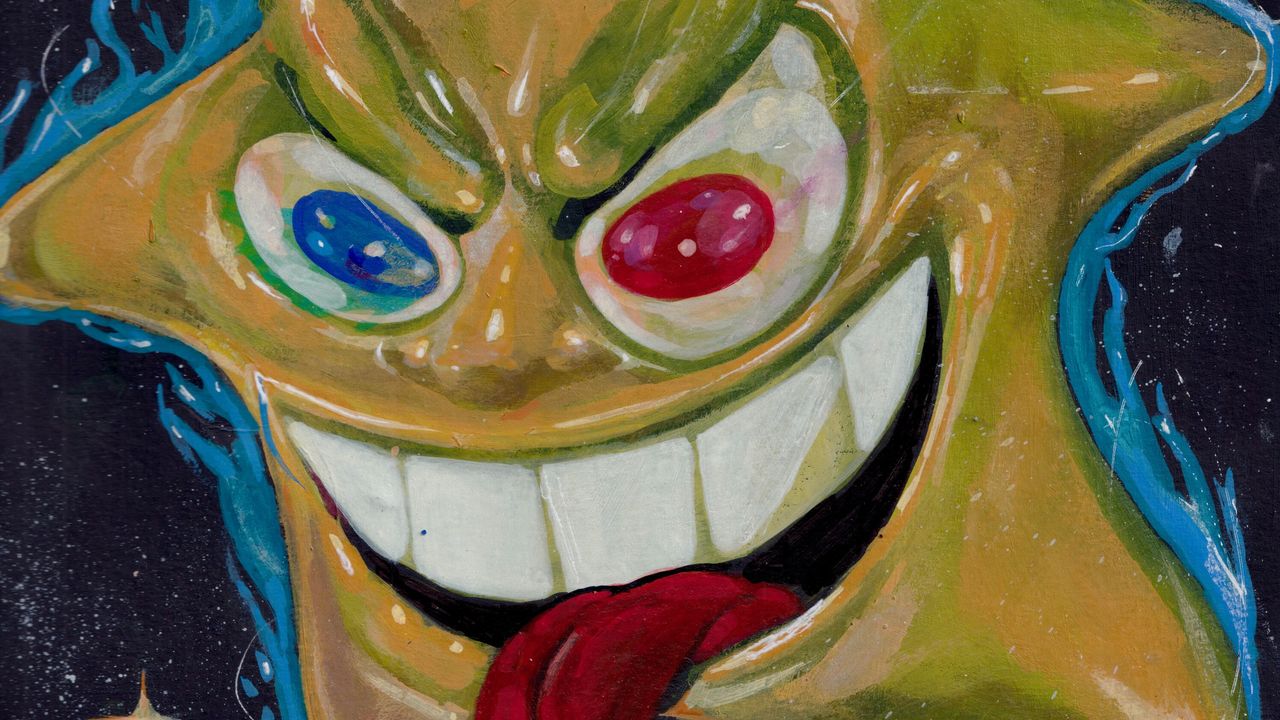
No Control, No Glory

Anyone who has attempted to start a daily journaling regimen can tell you how hard it is to truly get your thoughts down. It doesn’t necessarily come naturally to record your deepest feelings for posterity, or to make yourself confront the things you really need to say. In his songs, Brooklyn rapper AKAI SOLO tackles this challenge head-on, chronicling intense storms of personal experience that he strains to apprehend through language. He’s called his writing process “a game of how clever I can make my turmoil”; he makes his most humbling moments into fodder for thoughtful self-exploration he can share with others. On his new album, No Control, No Glory, AKAI uses a dizzying rap style to capture a range of moods while holding onto one consistent stream of consciousness. The result is an album that tries to map the rhythms of thought as they actually occur, without formulaic elements that might dilute the power of their expression.

AKAI accomplishes this with knotty, idiosyncratic writing, packing his songs with lateral logic-leaps and indirect imagery that asks you to follow his mind backwards and sideways as the music presses forward. Killing you becomes “turning you to a Ghost-type”; dust can’t “settle” unless it “gets a chance to get comfortable.” Often, he’ll take a convoluted string of ideas and repeat it as a makeshift hook, treating it with the breeziness of something shorter and less unwieldy (“All the way out in the Catskills, all to assess if cats are truly skilled/Anger is a acid few build a tolerance towards”). In just a few lines, he can place you in a scene, then summon a barrage of fake-outs and detours to give it the absurd shock of reality: “Battle rappers throwing ass in my phone…and I’m looking!…over my shoulder!” Each verse is a kaleidoscope, splintering life out into colorful, compact facets and revealing new dimensions as you turn it over.

By pushing past some of the assumed constraints of rap writing (rhymes at the end of each line, predictable verse structure), AKAI lets his creative instincts lead the way. It produces lucid performances, with each winding line organized to cut deep. The flexible approach connects him to dense writers like the Backwoodz crew and their Def Jux forebears, as well as other one-of-one stylists like Prodigy. AKAI’s command of the listener’s attention is most bracing when he raps in the second person to grapple with relationship dynamics. On “It’s Hard to Talk About,” produced by August Fanon, he bares his soul to a romantic partner as a melancholic jazz bass wanders underneath his voice. You feel like you’re in the room with him as his eyes linger on her, he reminisces about their early dates, and he sputters out insecurities (“you have a better relationship than me with my mother, go figure”). You almost forget that it’s a song at all—it feels like hearing a real, candid conversation, boiled down to its difficult essence by the work of songwriting. Love, frustration, nostalgia, need and despair all hang in the air, and none of these feelings are sidelined in favor of a neat resolution.

As AKAI thinks his way through these songs, shifts in his instrumentation and delivery track the mundane ups and downs of his life, and his emotions saturate the world around him in vivid shades. On songs like the Wavy Bagels-produced “Here’s to Hoping You Notice,” he trudges against the beat with the inertia of rumination, while charlieonthetrack’s “CALAMITYMAN” sees AKAI nearly giddy with triumph, raising his voice to a taunting bark: “Stick a needle in his fear, watch if his constitution pops!” Across the album, jazzy samples play off the improvised movement of AKAI’s thinking, like on the Lonesword-produced “Things that Stick With Me,” where an insistent, needling hi-hat keeps his flow brisk and vigilant as he sizes up the risks of violence and the pitfalls of trusting those in his midst. Most songs use familiar New York underground production to chart their emotional terrain, balanced out by fun sidequests like “Giggly,” in which AKAI smokes some weed and compares Detroit producer CoffeeBlack’s odd, spacey instrumental to Spy Kids. More muted or lackadaisical material still feels purposeful, like “HAKKYOU,” where Stability’s tinny beat and AKAI’s loose, teetering flow have the comforting feeling of a just-okay weekend after a tiring week.

No Control, No Glory never sounds insular or withdrawn; AKAI always faces outward and moves at a pace you can follow, trying to frame the abstruse parts of his individual experience in approachable ways. He makes this collective purpose explicit on the Mari Geti-produced “Free the World,” whose groovy marimba instrumental resembles something off the MIKE/Tony Seltzer projects. It’s a brash, confident song about the drive for self-determination, about always being willing to try again because you have “99 save files.” More broadly, it’s about connecting the struggles of oppressed people across the globe. “When I say ‘free the world’, I don’t forget nada/Not about Tigray, not about the Congo/Not about Sudan, not about Gaza,” he raps.

The refrain suggests a collectivist ethos—a mounting awareness of our communal responsibility against genocide, dispossession, and empire—that many have reached for, especially in the years since October 7. When AKAI repeats the lines a second time, it shifts from a rallying cry into a more solemn reminder, as a low-pass filter sucks the air out of the song, and all that’s left are the words in his head. Each group of people he mentions takes on a new weight. You contemplate all of those who have died, all of those at risk of dying, the harsh limits of one individual’s anxieties to effect change, and the need to participate in a wider movement regardless. Then the murk recedes, the song’s world opens up again, and the thoughts remain.