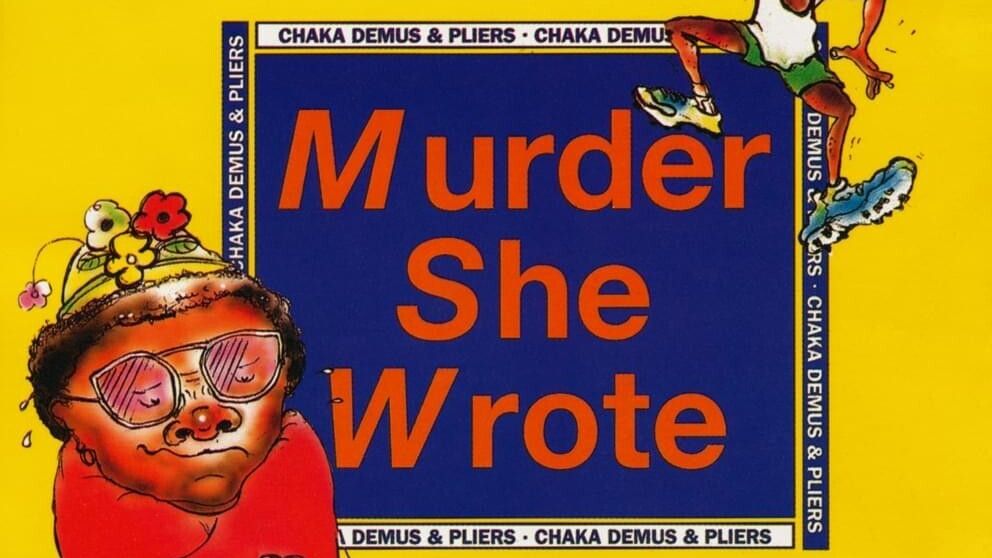
“Murder She Wrote”

Certain rhythms are so striking that you can recall the exact time and place they first demanded your full attention, a timestamp encoded in neck and hip muscles. But the rhythm track of Chaka Demus & Pliers’ “Murder She Wrote” is so distinctive that the opposite is true, its music somehow seeming to exist outside of time even as the Jamaican dancehall hit became a global phenomenon. The beat of “Murder She Wrote”—often called the “Bam Bam” riddim, after another Pliers tune sung on the same backing track—flows so naturally that it bypasses muscle memory and goes straight to the brain’s pleasure centers. Like oxytocin, the “Bam Bam” pattern triggers an amnesiac effect, erasing the memory of previous listens and encouraging the body to accept it again, thereby ensuring the survival of the species.

The neurochemical keys to this process are encoded in the song’s serpentine groove, a hypnotic inside-out drum pattern that’s difficult to resist and seemingly impossible for anyone but the late icon Sly Dunbar—who passed away this week at 73—to play accurately. As anyone who’s attempted to tap it out can attest, the snare seems to fall on every beat except the one you’re currently focused on, leaving the track anchored, in defiance of gravity, by atmospheric shakers and and the layered guitarwork of Dunbar’s Taxi Gang collaborator Lloyd “Gitsy” Willis: one layer an urgent Morse code pulse of rhythm guitar, the other a five-note ostinato worthy of a psychedelic cumbia. Somehow these sparse ingredients provide the perfect complement to the commanding bark of veteran dancehall deejay Chaka Demus (“Step up, my youth: Hear this!”) and the sweet melodic tone of singjay Pliers, all but guaranteeing the combination would grow into a worldwide hit. The rhythm’s uncanny lethean qualities would eventually stick to dozens, if not hundreds, of other vocals, making new hits time and again.

This seemingly timeless rhythm was born of a particular historical moment. It represented the peak of an early 1990s wave in dancehall, now remembered as a golden era both in creativity and cultural impact that resulted in major label deals and MTV airplay for artists like Shabba Ranks, and Patra. More importantly, it represented a moment of rapprochement in the musical conversation between Jamaica and the rest of the world, one over which Dunbar was, in some ways, singularly prepared to preside.

Cutting his teeth as a teen on early reggae sessions produced by Ansell Collins (“Double Barrel”), Lowell Fillmore Dunbar earned the nickname Sly via his predilection for Sly and the Family Stone covers while drumming for Skin, Flesh & Bones, the house band at Kingston nightclub Tit for Tat. To keep a full dancefloor, the gig required mastery of calypso, soul, funk, and early disco grooves, as well as reggae, and young Sly could do it all. Musicians from another club called Evil People, three doors down on Red Hills Road, would regularly come by on their break to check for the prodigious drummer.

One of these visitors, bassist Robbie Shakespeare, recruited Sly to join him on session work for producers Bunny Lee and Joseph “Jo Jo” Hoo Kim. It was at Hoo Kim’s Channel One studio that Sly & Robbie would change the sound of reggae in the mid-’70s as the rhythm section of house band the Revolutionaries. Forging a symbiotic relationship with Jo Jo’s brother, studio engineer Ernest Hoo Kim, the duo took reggae’s offbeat swing in a new direction, at once heavier and more fluid. In a mid-’90s interview with documentarian and punky reggae legend Don Letts, Robbie compared other Jamaican drummers to George Foreman (“Them come in like BOOF! BAF!”), forceful but slow-footed, while Sly, like a musical Muhammad Ali, achieved maximum impact from a lighter touch and constantly shifting emphasis.

Developing a technique that had as much in common with Max Roach or Tony Allen as with Jamaican counterparts Carlton Barrett or Mikey “Boo” Richards, Sly began using more of the kit than other reggae drummers, with their heavy reliance on kick and snare, earning the honorific “Octopus Man” by conjuring polyrhythms that might otherwise require a whole troupe playing in sync. “Jazz musicians would talk that Sly wasn’t really one person,” Robbie related to Letts. “Like Sly was one and Dunbar was a next one. Put 12 African drummers together, with 12 talking drum, six repeater man, five counters and the rest… Sly play everything. One day we a’go figure out how ’im do it.”

Sly’s many-armed facility helped the duo carve a niche internationally, parlaying work with Jamaican artists like Peter Tosh, Dennis Brown, and Black Uhuru into gigs with the Rolling Stones, Grace Jones, and many others as part of the house band at Chris Blackwell’s Compass Point studio in Nassau. It was this globetrotting—and longstanding association with Island Records—that indirectly sparked the “Bam Bam” riddim. “When I was in England,” Sly explained in a 2005 XLR8R profile, “I heard bhangra and, being a percussionist, I said, ‘This will be wicked to work with.’ So I went back down and we cut ‘Murder She Wrote.’”

In some ways, this story begins with Steven Kapur, a UK-born youth of Punjabi descent inspired by Bob Marley and Indo-Jamaican dancehall star Super Cat to take up the mic and deejay on the reggae soundsystems in his native Birmingham under the name Apache Indian. “Movie Over India,” Kapur’s 1991 debut, opens with a tabla and synthesizer riff that sounds like a clear precursor of the “Murder She Wrote” beat. On his next single, “Chok There” (also 1991), producer Simon Duggal took this fusion even further, alternating complex tabla runs and synthesized Punjabi folk melodies with an atmospheric dancehall pattern. Awkwardly termed “bhangramuffin,” the sound was a huge hit in the UK. Apache Indian was on his way to his third No. 1 on British Asian and Reggae charts by the time he signed to Island. “Chris Blackwell and everyone said, ‘OK so we need to know that you like reggae and you understand this thing,’” Kapur recalled in a 2021 interview with Toronto podcast 2 Lined Music Hut. “‘We’re sending you on the first flight to Jamaica next week. Soon as you land, you’re gonna go straight to Tuff Gong [Studio]. Sly & Robbie’s waiting for you.’”

On a track called “Don Raja,” Sly put his own stamp on the UK bhangra sound, creating a hybrid dancehall beat that incorporates a loop of sampled dholak—the signature percussion instrument of bhangra. It was in the midst of these 1992 sessions for Apache Indian’s No Reservations LP that Sly and Gitsy laid what would become the “Murder She Wrote” arrangement: Gitsy’s resonant guitar line and Sly’s nimble percussion approximated the effect of a tumbi and dhol pattern typical of bhangra, but they used a palette more natural to reggae. This influence was broadcast by the title of the 1992 compilation on Sly and Robbie’s Taxi Gang label that initially introduced “Murder She Wrote” in Jamaica: Reggae Bangara. (Although some releases include the blanket Taxi Gang credit “produced by Sly & Robbie,” the “Bam Bam” rhythm has no conventional bassline, and the composition is credited solely to Dunbar and Willis.)

Dancehall already had strains of Indian folk music within it; Steely & Clevie’s “Punanny” riddim, which dominated Jamaica in the late ’80s, features a tabla run on some versions. Even Sly had nodded to the sound before. “When I first used the bhangra thing, I used it on a song called ‘Almshouse’ with Capleton,” he said in his XLR8R interview, clarifying that he “used the tabla, but in Jamaica they call it the water drum.” In other interviews, he has emphasized Afro-Caribbean inspirations like mento and kumina for “Murder She Wrote,” and the instrumental version on Reggae Bangara titled “Santa Barbara” answers Gitsy’s twangy guitar (itself reminiscent of Toots and the Maytals’ 1966 proto-reggae boast “Bam Bam”) with a trilling electric piano part that seems to allude to the melody of Celina y Reutilio’s Afro-Cuban classic “A Santa Bárbara.”

“My idea was to make reggae at a large scale,” Sly told the UK television program The South Bank Show in 2015. “Take everything and take it to reggae.” Reggae, bhangra, kumina, mento, Afro-Cuban son—perhaps all of the above—in Sly’s polyglot hands, “Murder She Wrote” seems to arrive at a rhythmic ur-language, making it a hit not only in the Caribbean, Europe, and the States but in Africa, Latin America, and Asia as well. The Reggae Bangara comp was quickly picked up for wider distribution on Island’s Mango imprint under the new title Bam Bam It’s Murder, emphasizing how Chaka Demus and Pliers’ interpretation, already topping Jamaican charts, would become the first runaway hit.

Island also commissioned a new, high-budget music video, which put the song into regular rotation on MTV and BET and softened the somewhat chauvinistic lyric, based on Pliers’ youthful dalliance with a real-life Maxine (“Her beauty’s like a bunch of rose!”), whom he evidently suspects of having an abortion after claiming she is carrying his baby. An earlier, low-budget video features Chaka Demus acting out the lyrics more literally, berating a dancehall queen who is clearly just trying to hold a vibe long enough to demonstrate her skills. In the re-shoot, the artists join in the dancing with a whole crew led by bashment celebrity Dancehall Queen Carlene, reducing the accusatory tone of the lyrics to a mere fig leaf that spectacularly fails to cover the almost-naked appeal of ’90s dancehall’s sex positivity and bold DIY fashion.

The track’s success led to an Island album for Chaka Demus and Pliers, All She Wrote, which spawned its own hit singles when it was released in 1993. But their slow-building commercial success (“Murder She Wrote” was only certified platinum in the UK in 2024) belies the song’s true impact. Not only was Chaka Demus and Pliers’ gruff-and-sweet, odd-couple vocal pairing copied on subsequent hits by the likes of Shaggy and Rayvon and Tanto Metro & Devonte, but the rootless earworm of the “Murder She Wrote” beat also seemed to replicate itself endlessly.

King Jammy sampled it for Pan Head’s coochie-cutter anthem “Punny Printer.” Roof International’s Courtney Cole spliced it with a throwback rocksteady loop for “A Who Seh Me Dun” by Cutty Ranks, who then rode it to another hit (“Limb by Limb”) on the Fever Pitch riddim, a spin on “Bam Bam” from UK’s Fashion Records that also powered Louchie Lou and Michie One’s “Rich Girl.” The Star Trail label slowed it down for Beres Hammond’s infectious “Roadblock.” Bobby Konders sped it up for Sweet Tea’s Toni Braxton cover “Breathe Again.” At HC&F Studio in Long Island, Sancho blessed it with “Si Tu Sabes,” an early stab at Spanish-language reggae from the studio commonly acknowledged as the birthplace of the sound that would be known as reggaeton. The fact that “Murder She Wrote”—and its many offspring, like Fever Pitch—are still audible in the DNA of countless reggae, reggaeton, and Afrobeats productions in the 2020s is a tribute to its initial genius, a nomadic flex that felt equally local and exotic in every corner of the globe.