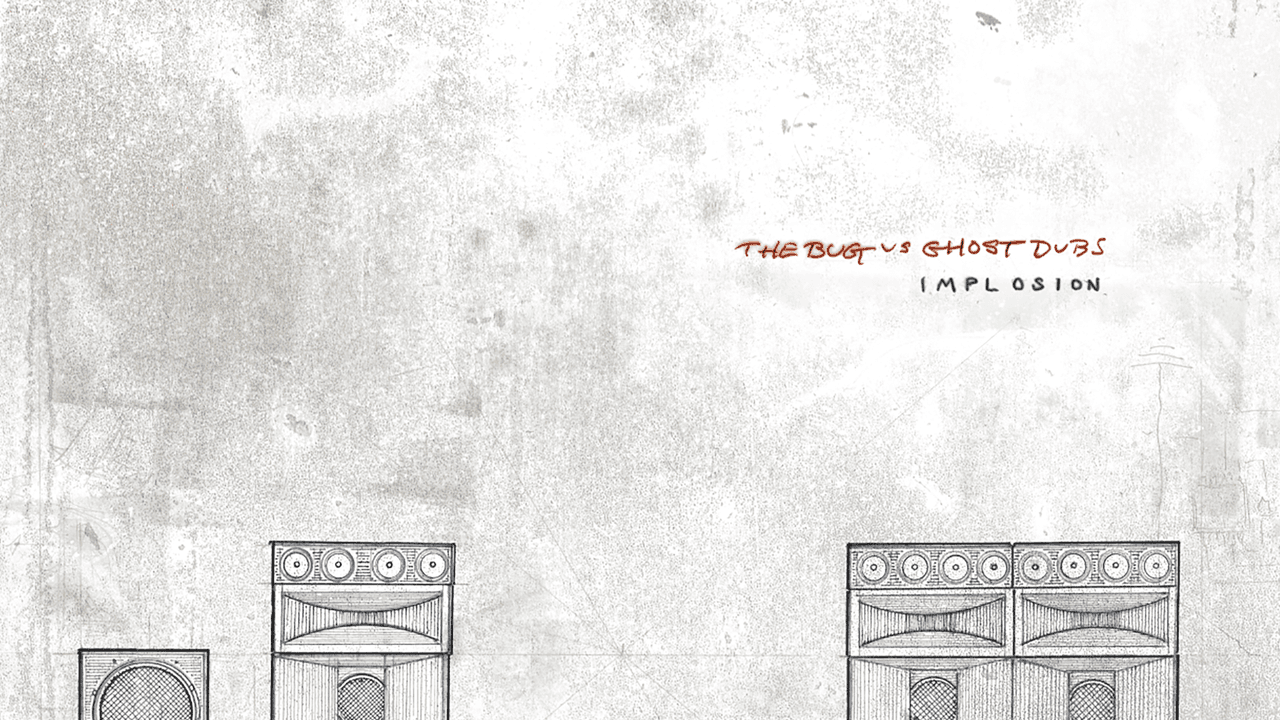
From industrial dancehall to leftfield techno to deep, alienating drone made with saxophones, Kevin Richard Martin welcomes the spirit of dub into everything he touches. Across three decades, the physical force of his music has expanded and contracted, but two things remain constant: the pulse of dub, no matter how reduced, and the rumble of the bass. “[The goal] was to make a new form of dub music that I wasn’t hearing,” he said of 2024’s Machine, his previous collection as the Bug featuring intentionally scuzzy instrumental music. “I wanted to make dub music that maybe some people definitely wouldn’t like.” The same motive could apply to Implosion, a collaborative album with Stuttgart artist Michael Fiedler, aka Ghost Dubs, that feels like a soundclash in the underworld.
Structured in a versus format with each artist trading blows, the album has a tension that makes its otherwise stone-faced music thrilling. If Machine was intended to make audiences physically uncomfortable, Martin’s tracks on Implosion use the same sonic devices for more introspective ends. Each of his contributions is named after a venue or nightclub, and these desolate tracks can feel like they’re reverberating through long-abandoned, decaying spaces. The music is lumbering, even by his standards, with basslines so belligerent they might trigger the lunk alarm. They’re also stop-you-in-your tracks heavy, like “Believers (Imperial Gardens, Camberwell),” named for a long-gone ’90s club. Here, ancient-sounding dub sirens and skanking basslines are fashioned into crude objects, the physicality making up for the billowing ambience.
Other tracks channel the mournful energy of the most political ’70s dub. “Burial Skank (Mass, Brixton)” is downcast and paranoid, looking around the corner upon returning to reality after a blissed-out night. “Spectres (Plastic People, Shoreditch)” captures the sensation of the air physically vibrating in front of you. It makes me think of how Plastic People’s sound system made dancers’ teeth shake inside their heads at London’s formative dubstep parties.