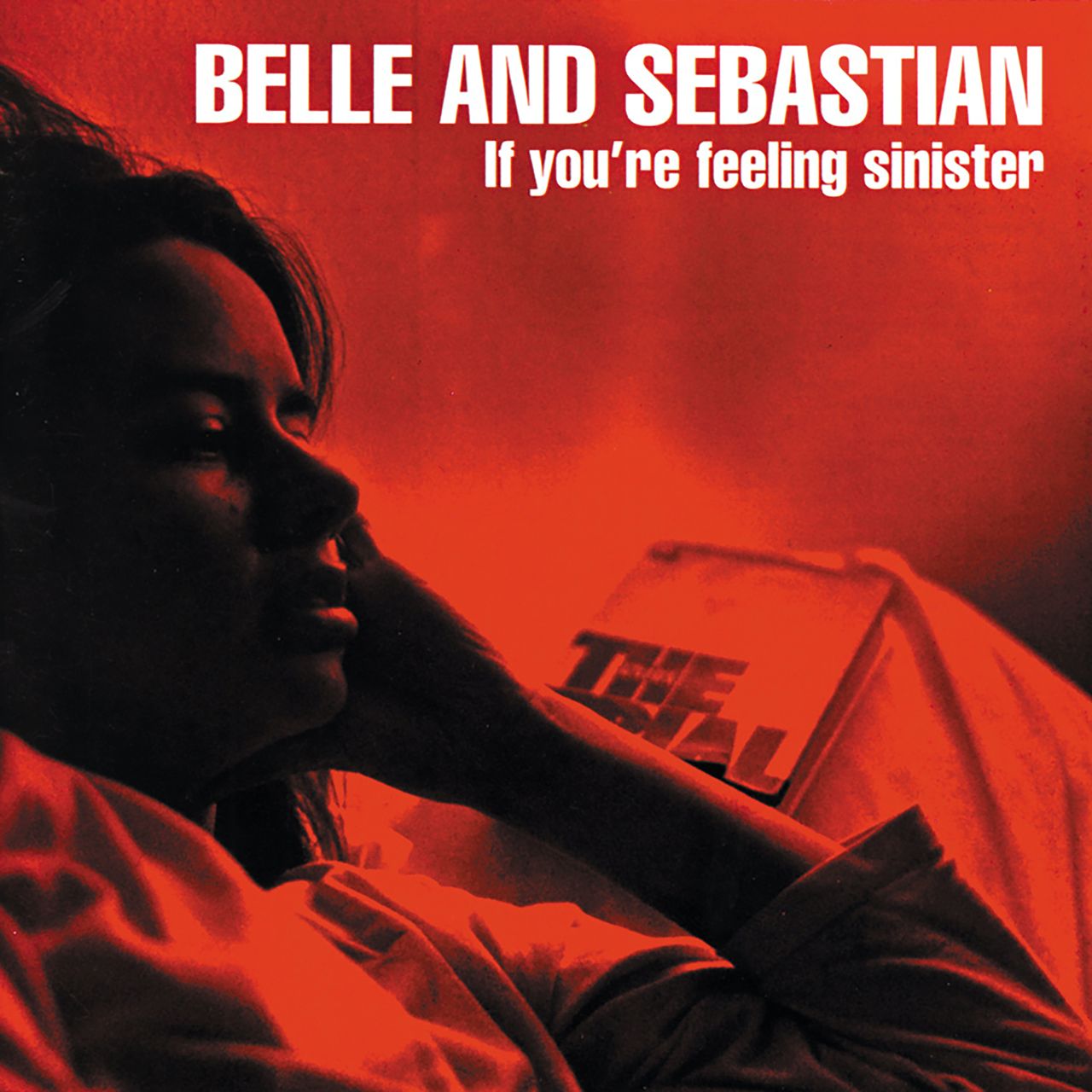
A timid teen is subjected to the romantic ministrations of a brazenly skilled young paramour and turns into a track star. A daily bus commuter slowly descends into a regular argument with an ornery old cuss who thinks the problems of today are all the fault of young people and glam rock. A street kid caught up in rough trade stops to wonder if that’s all there is. A spiritual seeker goes to a priest for guidance, and receiving only useless dogma in return, decides to worship television instead.
These are just a few of the faces that show up in 1996’s marvelous second LP by Belle and Sebastian. At once rousing and mournful and positively buzzing with the erotic friction of sin and salvation, If You’re Feeling Sinister manifests an unarranged meeting of disparate outlaws—the lineal descendants of Bowie’s pretty things, the Modern Lovers’ disaffected suburban bohemians, and Paul Westerberg’s invisible strivers. In 10 songs, singer-songwriter Stuart Murdoch constructs his shadow kingdom piece by piece, an emotional voting block of consummate misfits: the poor, the ugly, the queer, the socially maladroit, those for whom the compensations of contemporary life feel insufficient relative to its nonstop petty humiliations. A shimmering, comic-tragic signal flair for those who feel abandoned and a destination for those with nowhere to go.
No score yet, be the first to add.
Five months earlier, the band made waves with their frequently brilliant and charmingly homespun debut Tigermilk, which helped to establish the rough contours of Murdoch’s preoccupations: dancing, dreaming, shy boys, sly girls, high-school hierarchies, the plight of the unrequited, and the sundry pilgrimages of the heart and mind. It was by any measure a strong statement of purpose, buoyant and scrappy and replete with promise. If You’re Feeling Sinister was something else entirely—a streamlined juggernaut whose layered character studies were filled with exquisite literary and musical detail. Such is the power of Murdoch’s storytelling that it can be easy to lose sight of the idiosyncratic brilliance of If You’re Feeling Sinister’s marvelously calibrated hybrid of Fairport Convention-adjacent British folk and late-period Velvet Underground surliness, a hiding-in-plain-sight aesthetic pairing that provides a rich sonic tapestry for Murdoch to embroider his outsider’s guide to the galaxy. The pastoral feel of the music, and Murdoch’s soft, tremulous tenor conjures Nick Drake, but the content of the songs hews closer to the urban fever dreams of Martin Amis, whose 1995 novel The Information traces similar lines of fading-empire disenfranchisement.
Stuart Murdoch is a character in his own songs, largely a comedic one, and he tends to exist at a remove. A lapsed-but-simmering Presbyterian zealot, he’s always calling balls and strikes on everyone’s perversions but his own. He’s a strange anthropologist of the underground, a little overstimulated, thrilling to the milieu without quite jumping in—a beguiled wariness regarding the weird edges of town he shares with his Canadian contemporary Dan Bejar. He asks peculiar questions. “Have you and her been taking pictures of your obsessions?” he gently interrogates a young woman in a detective’s cadence on the spectacular album opener “The Stars of Track and Field.” He’d like to know, because he has definitely been taking pictures of his. The rollicking, seasick “Seeing Other People” is a piano-driven paean to bewildering bi-curious sexual confusion, resolving around a killer punchline: “You’re going to have to go with girls/You’d be better off/At least they know where to put it.”