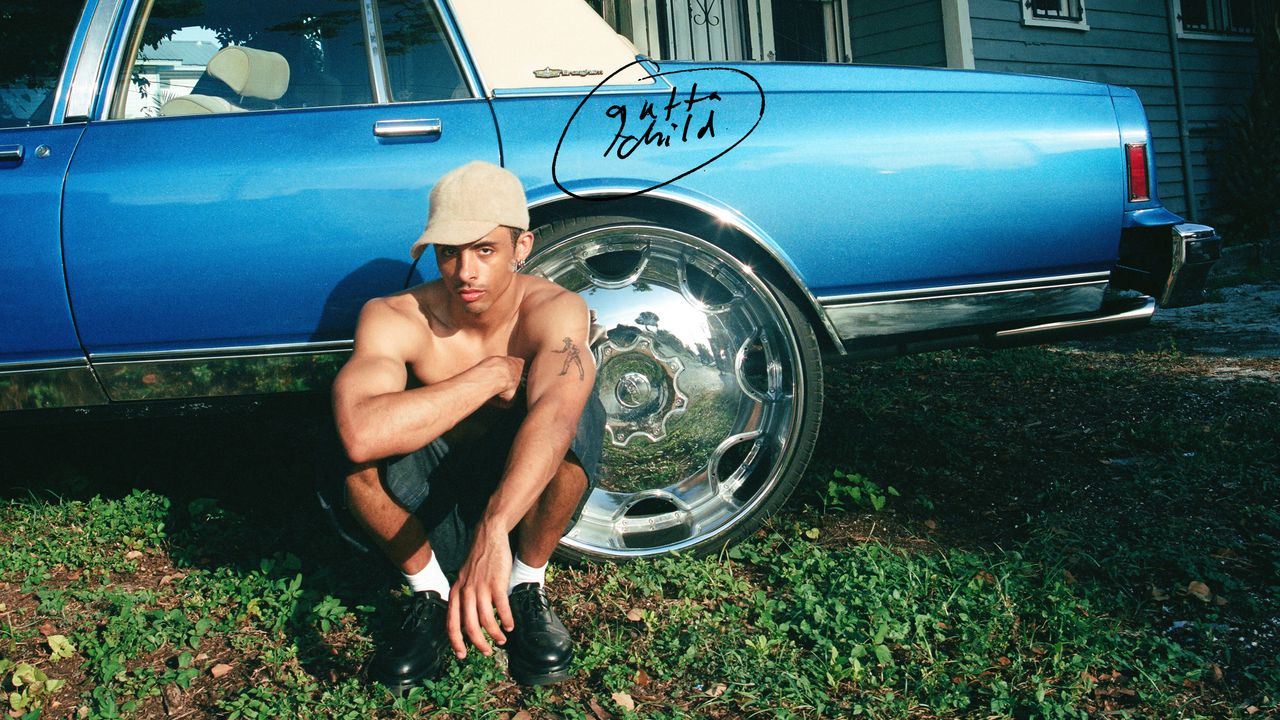
gutta child is an odyssey that feels like a jaunt. In 20 feverish minutes, Gabriel Jacoby coos, raps, rasps, and scats his way through decades of Southern music. Yoking together backwoods blues, bayou funk, and earthy R&B with Dungeon Family bombast, the Los Angeles-based singer and producer pens love letters to the sounds and places that shaped him. He makes roots music that looks to the sky more than the soil, paying it forward by surging up and away, his heritage the jet fuel.
A self-taught guitarist with roots in South Carolina and Florida, Jacoby brings his lineage to life with studied focus. He and a tight cohort of producers and session musicians layer the songs with relentlessly funky horns, keys, and basslines that appeal directly to hips and feet. The tracks bounce and swing like airboats cutting through swamp water and seem to sway even when still. Guitar licks, record scratches, and dollops of harmonica and banjo up the homespun flair. Every arrangement feels warm and communal, as if the songs were recorded around a crackling bonfire. Donnie Trumpet and the Social Experiment’s Surf comes to mind as the songs fill with instruments and voices, especially when Jacoby playfully squeals and spumes like Chance. But the songs are tightly edited down, each sound a brushstroke realizing Jacoby’s vision of home.
His writing is downhome and clever, full of impressionistic details that mix idiom, hyperbole, and autobiographical precision. A “corner lady” sells “sugar water” at a long traffic light on opener “hello,” a cheeky ode to tricking. The jittery “bootleg,” which recalls Justin Timberlake’s “Like I Love You,” nods to krank, a Tampa form of footwork, with jangly drums and lively rhythm guitar. Even when Jacoby draws on more familiar images of the South, he grounds them in his experiences: “Mama in the kitchen, let me see what’s boiling/Carolina water, mix it with that Florida/Somebody said, this ain’t what they ordered/I could give a damn, this is what I am,” he raps on the title track, strutting through finger snaps and a groovy bass melody. “gutta child,” like “OutKast” or “project baby,” is a badge of honor.