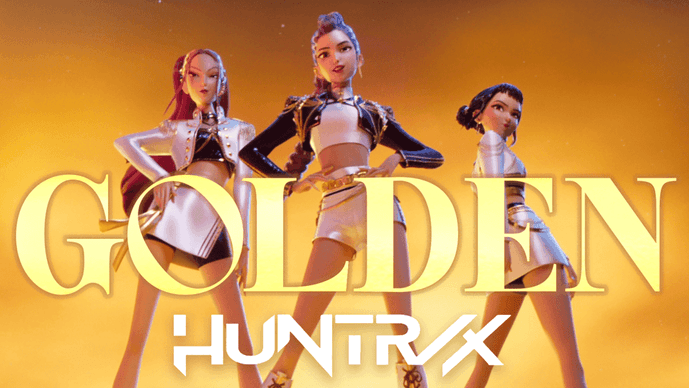
“Golden”

In 2021, Sony Pictures developed an offbeat animated film with a high-concept title; Netflix covered the budget and guaranteed Sony $20 million in profits. Then Netflix dumped the film on streaming with minimal advance marketing. They had no idea what they had on their hands. Five hundred million-plus views, four simultaneous Hot 100 Top 10s, and two Oscars later, K-Pop Demon Hunters is one of this decade’s biggest cultural phenomena. There’s no greater proof than “Golden,” not the first song released—that would be the demon diss track “Takedown,” covered by TWICE—but by far the biggest. In-universe, it’s K-pop trio HUNTR/X’s new single; in our universe, it’s a hit that seems both out of nowhere and comfortingly familiar.

At the moment, there’s a relative dearth of thoughtfully made media for kids: On one extreme, the media ostensibly for children exists to soothe their parents’ inner child; on the other, the kids are watching AI-generated slop unsupervised on YouTube. K-Pop Demon Hunters fills the gap, unapologetically indulging every kids’ movie cliché with little of the jaded postmodern “lampshading” that many contemporary animated films love. The accessibility of Netflix means it’s easier to watch, and thus much easier to spread. And from its pop-star protagonists to its side characters (like the hojakdo tiger and magpie) to its food (Rumi loses her mind over kimbap in the film’s most viral moment), everything draws inspiration from Korean art and culture, something Korean Canadian director Maggie Kang hadn’t yet seen depicted in Western animation.

Kang had an idea about a story with demons and an idea about female protagonists with a silly streak, and her husband suggested putting them together. She developed a main trio that’s both, as co-director Chris Appelhans recalls Kang saying, “so badass and so stupid”—likeable but still capable of kicking demon butt. The title explains half the concept: Girl group HUNTR/X moonlight as demon hunters, and the combination of music and fans’ souls creates a shield called the Honmoon, protecting Earth from demons. To fight the trio, the ruler of the demon realm, Gwi-Ma, sends an evil boy band that steals souls. Meanwhile, HUNTR/X leader Rumi (voiced by Arden Cho and sung by Korean American songwriter EJAE) must keep her half-demon side a secret. The summary sounds slightly cynical—a K-pop movie where fan engagement and parasocial attachment save the world?—but, as with the combination of pop art and brand management in Sony’s Spider-Verse franchise, it’s earnest enough to compartmentalize while watching.

In some respects, this is a victory for long-incoming American K-pop acceptance: a megapopular gateway into the genre and its tropes. In the streaming era, when original movie musical songs cross over, they become pop songs by default: Disney tried to make Demi Lovato’s version of “Let It Go” a hit when Frozen came out, but Idina Menzel’s was unfathomably more successful. 2021’s Encanto forewent the pop cover and still got a No. 1 hit with “We Don’t Talk About Bruno.” 2017’s The Greatest Showman became a sleeper success in part because Pasek and Paul’s platitude-heavy songs had almost no direct connection to the narrative, like Top 40 songs that just happened to interrupt a P.T. Barnum biopic. Demon Hunters’ songs cannily work in multiple contexts: Every line pushes the story forward and every hit is diegetic.

The primary authors of “Golden” come from theater and from Korean pop: Songwriter Mark Sonnenblick wrote for The Devil Wears Prada musical and films like Lyle, Lyle, Crocodile. For EJAE, it’s a longer story. Like Rumi, EJAE was torn between worlds: Her alto didn’t fit the cleaner vocal styles expected in K-pop, and she couldn’t find other American pop stars who looked like her. For over a decade, she was a K-pop trainee under SM Entertainment, splitting time between boot camps and acting school before SM ultimately dropped her. She later wrote for acts including Red Velvet and Aespa; Kang now credits EJAE’s demos with convincing Sony to greenlight Demon Hunters. “Golden” was the final song written: On the way to a dentist appointment, EJAE wrote topline ideas over a beat from THEBLACKKLABEL, and co-writer Sonnenblick later chopped the ideas up to create the song’s melody. Absent the film’s context, “Golden” is a classic “victim to victory” song, as Sia once called it: After quieter verses, it traverses over two and a half octaves until EJAE sings, “I’m done hiding, now I’m shining, like I’m born to be!” On “born,” she belts an A5, especially impressive from an alto singer.

That turns singing along into an impossible but addicting challenge. If EJAE can’t sing “Golden” live in the original key, transposing it down a step, there’s no hope for the rest of us—but that won’t stop kids from trying and adults from mocking the screech. Whether it’s the even higher E6 from Phantom of the Opera, or the soaring ending riff of “Defying Gravity,” vocal acrobatics are a large reason these kinds of songs enter mainstream consciousness. Virtuosity sells, especially on a song difficult enough that even Kelly Clarkson, who sings covers on her show every week, brought up vocal theory to explain why she hadn’t attempted it yet.

Still, “Golden” is a little more clever than it appears, an “I Want” song written as if the trio already has it all—Sonnenblick has called it a “false victory” song. Hear “Golden” on the radio, and it might as well be Katy Perry’s “Firework”; hear it in the context of the film, and it’s oddly bittersweet—revealing Rumi’s struggle to hide her demonic side from her peers, giving what sounds like a generic anthem real weight in the story. Compressing three characters’ worth of narrative into a tight pop song is a challenge: The snarky Mira (voiced by May Hong and sung by Audrey Nuna) calls herself “a problem child,” and Zoey (voiced by Ji-young Yoo and sung by Rei Ami) alludes to her challenges as a Korean American trying to “play both sides,” but this is Rumi’s story, so she gets the most development and most of this song. Everything else is left to fan imagination until the inevitable sequel, reportedly set for 2029.

Kang has said that the team used existing pop songs as temporary tracks while writing the film, and later created new music based on that material. Perhaps that’s why K-Pop Demon Hunters songs feel so familiar: They take inspiration from the most mainstream K-pop groups and mid-2010s American pop. The creators cite West Side Story, but “How It’s Done” is pretty much exactly what would happen if BLACKPINK made the 2014 Jessie J posse cut “Bang Bang”—and it’s not the first K-pop song to resemble it. While Kang thought of first-generation group H.O.T. when crafting her villains, it doesn’t take a K-pop expert to link the Saja Boys with the Bangtan Boys, and the key change in their song “Soda Pop” even evokes BTS’ English crossover hit “Dynamite.”

Outside of KATSEYE, “Golden” really is the clearest K-pop meets A-pop hybrid yet. As critic Katherine St. Asaph points out, it fuses the chord progression from IVE’s “I Am” (it’s not lost on them) and the pumping synth bass from Carly Rae Jepsen’s “Run Away With Me”; both “Golden and “I Am” share the same high-speed 12/8 bounce, constantly tumbling over themselves to get to the next hook. “I don’t think of mixing K‑pop any differently than mixing American pop,” “Golden” engineer Curtis Douglas told Sound on Sound. “I think of the songs as what they are—big pop tunes.” There hasn’t been a pop tune that sounded this big in years.

The success of “Golden”—over a billion streams; an Oscar, a Golden Globe, and a Grammy; the top of the Hot 100—definitely owes something to its perceived optimism. In a sentence unthinkable 15 years ago, our culture is currently starved for aspirational anthems. Many of our biggest stars are simply too jaded: Morgan Wallen is bitter and self-loathing; even Muppet Show guest Sabrina Carpenter is operating on post-ironic heterofatalism. “Golden” is as defiantly optimistic as the best of the It Gets Better-era anthems like “Firework” and “Born This Way”—it makes me nostalgic for the kind of songs I found annoying as a kid. Of course, sticking so closely to that template is a double-edged sword: K-pop finally has a full, organic crossover, and it’s nearly indistinguishable from American pop songs from before the target audience was born.

It’s a surprise in the movie when “Golden” isn’t a fluffy pop song the way it’s become in real life. Ironically, the song never plays in full during the film, always interrupted by another plot development, though its melody recurs multiple times in Marcelo Zarvos’ score. It’s another sign that nobody quite understood just how ingenious and well-timed Demon Hunters’ cultural synthesis was going to be. Netflix now calls the film and potential franchise their Frozen, and in her Oscars acceptance speech, EJAE expressed amazement at hearing young English speakers sing the Korean lyrics in “Golden.” As other studios move away from personal stories or capitulate to Trump administration pressure, it’s refreshing to see something so relatively innocent get so big. Like K-Pop Demon Hunters, “Golden” wears its influences and its heart on its sleeve, and that’s exactly why it works.