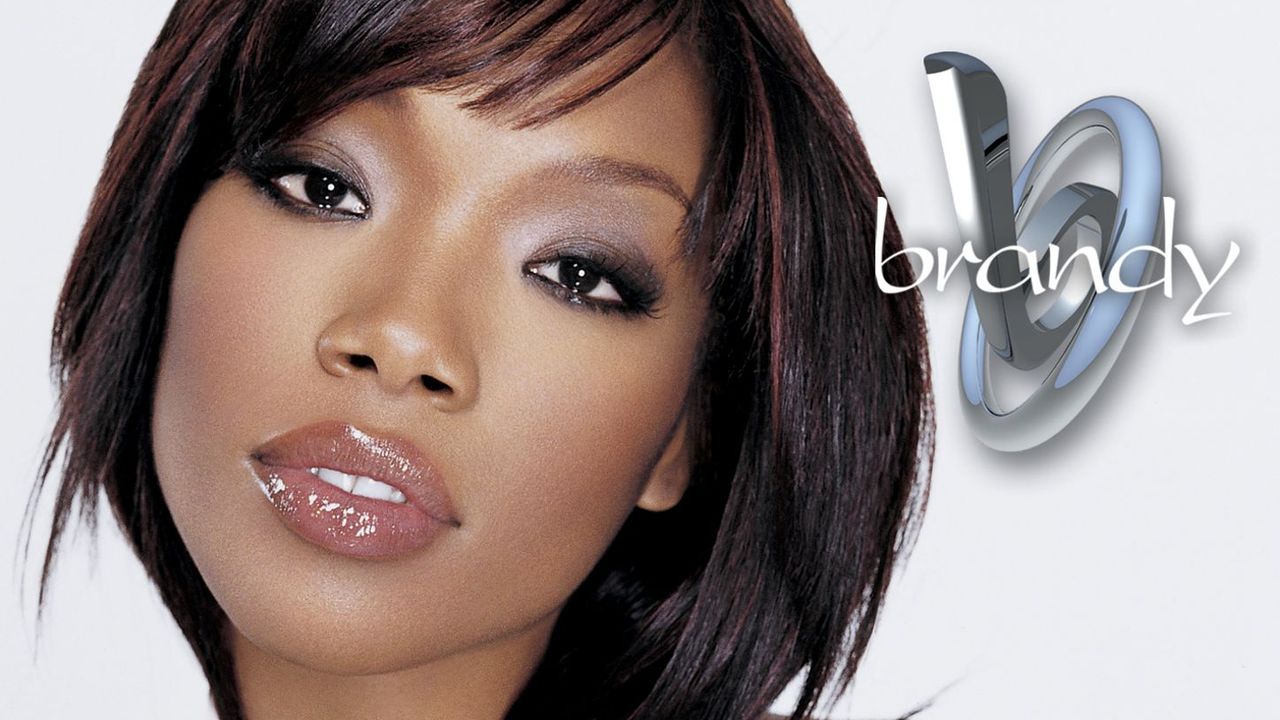
Full Moon

By 1998, Sunset Gower Studios had set the stage for nearly a century of TV and film history: from Mr. Smith Goes to Washington to Funny Girl; Bewitched and Saved by the Bell to The Golden Girls. That year the storied lot also played host to Moesha, the one and only hit sitcom on the fledgling—and quickly tanking—network UPN, which had just begun filming its fourth season. The show’s titular main character was played with charm and vulnerability by a 19-year-old Brandy Norwood, who, by season four, had become as synonymous with Moesha the character as she was with the music she made with her own name. The season’s premiere episode even celebrated the conflation: Moesha, played by Brandy, finally meets her idol, Brandy, also played by Brandy. Cute, right?

The effect was anything but for the woman at the center. Instead, it was a rupture. “After years of living in [Moesha’s] world,” Brandy writes in her new memoir, Phases, “something inside me snapped like an overstretched rubber band.” She did the unthinkable: She walked out of Gower without telling a soul. “The good girl in me wouldn’t have dared. But today, she was dead.” Brandy wasn’t being dramatic. Her subsequent breakdown, exacerbated by an eating disorder and physical exhaustion, marked the end of her years as America’s sweetheart—and one of its most profitable stars. “I had become a brand—a product to be packaged and sold,” she remembered. “And the pressure to maintain that image—that flawless, bubbly, wholesome image—was suffocating me from the inside out.”

Reader Score

No score yet, be the first to add.

0.0

She’d been saying yes for the entirety of her adult life. Yes to season after season of Moesha. Yes to recording, at age 15 and at breakneck speed, her first of two multiplatinum albums, with gargantuan world tours wedged in between. And most of all, yes to being the first: one of the first Black celebrities to have her own Barbie doll. The first Black singer to land a Cover Girl campaign. The first Black princess, when she starred as Cinderella alongside her idol Whitney Houston, another generationally talented Black woman forced into impossible perfection and later punished brutally after cracking under it.

The biggest realization Brandy came to after her breakdown was excruciating to admit: She had no idea who the hell she was as a person. She was, in her mind, “a question mark in designer clothes.” Starting over was first impossible, then daunting, and then slowly manifested through a combination of therapy and more spiritual remedies (brief flirtations with Scientology and the Nation of Islam didn’t take hold). Freedom became something real—freedom from expectations, yes, but more thrillingly, the freedom to decide who this new, complicated Brandy Norwood was as a creative force. On her way to figuring out who she was as a person, she finally realized how she wanted to sound.

This was where Brandy found herself when she began work on what would become her masterpiece, Full Moon, an album that, in the years since its release in 2002, has been recognized as the foundation for contemporary R&B, and which paved the way for a litany of singers attempting to mimic its vocal technique, from Ariana Grande and Kehlani to Solange and Ty Dolla $ign. But before Brandy became revered as the Vocal Bible, all she’d wanted was to sound like Michael Jackson. Not exactly like him, but to understand and replicate the magic he conjured when he stacked his voice for his background vocals and stadium-filling choruses.

She’d first learned about Michael’s layering style from Quincy Jones, who told her how Michael arranged his vocals, identical track on top of identical track and one note at a time, to form a mountain of sound, a shapeshifting instrument pulled from an alien planet. It wasn’t as simple as lumping together a single note 10 times; it was a practice that required meticulous patience. Thriller’s title track shows what vocal layering can do; those harmonies on the chorus are so familiar you easily forget Michael sang each track himself, one take at a time, and arranged them on top of and within each other, all of it interlocking like the inside of a watch.

On her second album, 1998’s quintuple platinum Never Say Never, Brandy and her main collaborator, Rodney “Darkchild” Jerkins, had played around with what would become Brandy’s signature take on layering on songs like “Angel in Disguise.” But it was only during the Full Moon sessions that Brandy (and co-vocal producer LaShawn Daniels) really began trying to do it Michael’s way. “Sometimes we’d stack 16 separate takes of me singing the exact same note for just a tiny section of a song,” Brandy writes. “I attacked every note like I was scaling Mount Everest, pushing past where comfort ended—then pushing even further.” Her voice—newly deepened and textured—became the most important instrument in the room, the centerpiece of every song. She began to encounter a truer self.

R&B at the turn of the century was already an arms race of technical innovation and landmark commercial success. TLC and Destiny’s Child conquered pop while Timbaland’s work during this period, producing era-defining albums by muses such as Missy Elliott, Aaliyah, and Tweet (and later Justin Timberlake), married everything from Bollywood, opera, and the Southern hip-hop of his native Virginia to reinvent what the radio sounded like; he’d go on to be Brandy’s main collaborator on Full Moon’s followup, Afrodisiac. To make R&B in 2002 was to feel galvanized about the rules you were going to break along the way. Going as far as possible was a known path to success.

Still, even in this context—even as Sisqo adorned a song about thongs with baroque strings and extravagant chord modulations—Full Moon stands above. Its somewhat lukewarm reception and, compared to 1998’s Never Say Never, disappointing sales only belie how ahead of its time it was. Disorientingly abrasive in one turn and soulful in the next, teetering on the edge of chaos but always returning to stasis, “it sounded like what I imagined the inside of a computer would sound if it made music,” Brandy writes in Phases.

On the surface, the album’s hiccuping drums, dense harmonies, and dramatic vocal runs might sound like the Timbaland-produced hits and imitators of the time, especially since Jerkins had already played an enormous part in R&B’s renaissance himself, with songs like Destiny’s Child’s “Say My Name” and Brandy’s own “The Boy Is Mine.” But Jerkins wasn’t recycling old tricks, nor was he biting other producers’ style. He was stuffing each song with as much as possible—the R&B of the day but also a batshit combination of UK garage, glitch, electronica, and gospel—while still making it work for the masses, a balancing act in the worldbuilding tradition of Jimmy Jam and Terry Lewis’ work with Janet Jackson.

In other words, Jerkins was playing chess while others were playing checkers. He brought more than just interlocking, speaker-splitting instrumentation to the table. Like the best producers, he and his team—namely his brother Fred and songwriters Daniels, Nora Payne, and Kenisha Pratt—laid a creative foundation that forced their artist to innovate. Oh. My. God. is all Brandy can say when she first hears a snippet of the confrontational and absolutely vibrational third track “I Thought,” played to her over the phone in a skit preceding the song. This is how she wanted to sound; she simply hadn’t known how. It even took a cockier new persona—B Rocka—to unlock it.

By the time she starts singing, she comes out shooting: “You claimed you love me,” she sings, as her background vocals answer back, No, you didn’t. “But you made a fool of me!” Brandy was pulling from her real life in a way she never had. She put those big feelings in the venom and precision of her delivery, which transforms run-of-the-mill lyrics into rocket fuel. Preceding and during her breakdown, she had endured a volatile romance with Boyz II Men’s Wanya Morris, who Brandy later accused of grooming her in Phases, and a relationship with an unnamed, emotionally abusive background dancer who dismissed her nadir as theatrical. Finally, she had found the music that would allow her not only to break free from being the girl next door but also to experience an urgent and overdue emotional catharsis. And what she couldn’t convey, the complexity of Jerkins’ production would communicate.

The introduction to “It’s Not Worth It,” another exploration of post-love confusion, begins with quintessential, multi-part Brandy harmonies, before a brief twinkle of Y2K computer noise bleeds into strings, a voicemail, and Michael Jackson’s own lilting falsetto (Jerkins, in a full-circle moment, was going between Jackson’s studio for Invincible and Brandy’s in Miami while making Full Moon. When Brandy finally met Jackson, she fainted). On first listen, these first 45 seconds sound like self-indulgent throat clearing. But then the actual song starts. A woosh of pitterpatter drums builds to a chorus that somehow throws open the windows and invites in everything we were teased with at the start, violins and glowing keys and MJ and Brandy’s voices swirling together in a gust of pleading and disappointment (there’s a beatboxed bridge, too, but I won’t even get into that).

This maximalism wasn’t only the approach to back-half album cuts. Just listen to the brash drama of lead single “What About Us?”, a supernova of cascading synths and stuttering drums that inflames Brandy’s festering resentment. Her voice seems to be both fighting against and emerging from the music itself; on the call-and-response second verse, she layers herself on top of the instrumental melody, becoming one with the machine. Or the blistering, dizzying “All in Me,” maybe the album’s most audacious concoction, with an arpeggiating grouping of keys, violins, guitar, and harp exploding, halfway through, into a frantic doubletime sprint, only to slow down just as fast, Brandy’s straining vocals stretching across tempos like an extended exhale.

The transformation of Brandy’s voice into something deeper and rounder made her capable now of moving smoothly between a warm, pockmarked lower register and a steady falsetto, more able than ever to perform the controlled, dynamic melisma that runs throughout the album. Her newfound control of that tactile lower range deepens and enriches simple, slightly mournful songs like “Nothing,” and when she reaches high across the slowly brewing chorus of “Apart,” her new falsetto allows her to explore the nuanced difference between betrayal and anger. The nocturnal and resplendent Mike City-written-and-produced title track, the album’s second single, and one of only two songs not touched by team Darkchild, is the full package, using stacked background vocals to amplify the production’s bass on the verses and molding Brandy’s voices to the horns on the chorus. By the unleashed final hook, she is using essentially every register of her voice at once. The effect is all-consuming.

The changes weren’t limited to just her voice: Brandy was also falling in love. Jerkins’ family operation included his cousin, Robert Smith, known as Big Bert, with whom Brandy began a clandestine relationship as the recording progressed. Full Moon isn’t all force; in Brandy’s imagining, the record would serve as an exploration of an entire relationship, and fittingly the love songs here shine. The new millennium had introduced a range of breakthrough neo-soul acts–Musiq Soulchild, Floetry, India Arie–whose music coursed with devotion and intimacy. In Brandy’s case, her takes on love are flush with a particular sparkling excitement, as if they were being sung directly to the person Brandy was hoping to fall in love with—because, probably, they were. The organ-laced “Like This,” propelled by delicate anticipation, is Brandy-in-love at its best. No longer was she a teenager sitting up in her room, daydreaming about a more adult love forever on the horizon: She was making it come to life. “I’ll tell you where to kiss/And you’ll begin to kiss,” she sings through a smile, sliding into the future, somewhere between fantasy and authority, increasingly cocksure but still needing reassurance. When she arrives at the penultimate “Wow,” co-produced and co-written by Bert (and an undeniable predecessor to Beyoncé’s “Irreplaceable”), she’s basking in the revelation of unprecedented mutual love, her journey complete, her world finally brighter. By the time she finished recording the album, Brandy was pregnant.

What came next was difficult. She and Bert split a year later, and the reception to Full Moon was decidedly mixed, some of its harsher critics outright dismissive; her pregnancy also cut her press tour short. Fittingly for music meant to sound like the future, it would take until the early 2010s for Full Moon to gain its rightful place in R&B’s pantheon and for Brandy’s retrospective recognition as the Vocal Bible (Solange, who has repeatedly discussed her worship of Brandy, tweeted some instructions in 2016: “don’t you ever dare speak that 6 letter name without understanding the value”). The price she paid for making the album and for the reclamation of her agency as a singer and public figure was significant: Never again would she go platinum after this, and her influence—gigantic to generations of singers—nonetheless continues to feel under-recognized. (In a particularly painful and foreshadowing scene in Phases, as she and Darkchild fall out over his commitment to her music around 2004, she remembers him snapping, “Go do what you’re gonna do, while I go sell five million records with Beyoncé.”)

For an album presented as a mission statement of creative independence, Full Moon, apart from its cracking of R&B’s source code, doesn’t go to lengths to explain itself, for better or worse; the lyrics can feel rote when taken out of context (my bad), the emotional beats at times familiar. Brandy often remains, here, a question mark in designer clothes. But the story at the album’s heart, what it captures without ever saying, is one of leaving childhood behind: embracing, tentatively, what it feels like to live on your own, to greet the world in its intensity and joy even if you’re still figuring out how to do it, to be sexual, angry, scared, proud, hopeful, and, in Brandy’s case, to be 23 and preparing to be a mother. When the entire world watched you grow up—as Brandy Norwood, as Cinderella, as Moesha, as Moesha meeting Brandy Norwood—leaving behind the suffocation of that supervision results in an album’s worth of giddy, nervous possibility. I still feel wonder each time I hear the twinkling intro to “Full Moon”: It sounds like the start of something unforgettable—a night out, a one-night stand, a new name entirely. It sounds like the start of an entire life.