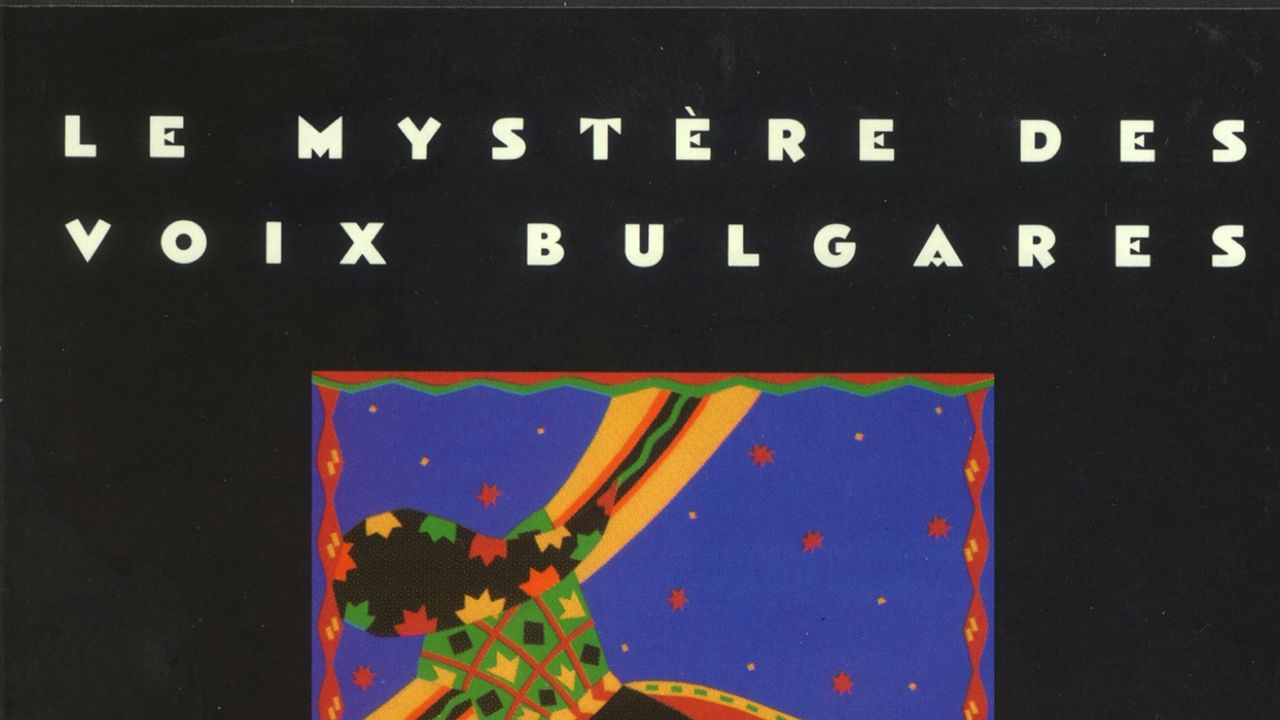
Bulgarian State Radio & Television Female Vocal Choir: Le Mystère des Voix Bulgares

Although the Bulgarian State Television Female Vocal Choir formed less than a century ago, with a verifiable context and history, writers and listeners still treat the ensemble’s music with the same mystification reserved for the pyramids of Giza, the menhirs of Stonehenge, or the cave paintings of the Neolithic age. Their demonstrations of the human voice are exceptional, presenting new possibilities as they transcend the mechanics of the throat, the grain of the body.

The shock of encountering sounds this extraordinary tends to bypass familiar categories and break into the realm of the inexplicable. The music baffles. But beneath its mystification lies a compelling story of folk repertoire, Communist propaganda, and the repeated suppression—and reimagining—of cultural identity, distorted by Western commerce and the label that reads: “world music.”

In 1986, the British label 4AD—followed by U.S. distributor Nonesuch in 1987—reissued a little-known 1975 anthology of recordings of the Bulgarian State Radio & Television Female Vocal Choir licensed from Swiss musicologist Marcel Cellier: Le Mystère des Voix Bulgares. Originally released on Cellier’s private Disques Cellier label, the album documented a government-employed ensemble singing modernized versions of Bulgarian village songs.

The ensemble was first formed in 1951 by composer Filip Kutev, who reworked monophonic village tunes into multi-part harmonic arrangements that drew from Western choral singing while preserving the ardent throatiness of Bulgarian folk. His scoring, which blended Bulgarian rootsiness with avant-garde, bore traces of Stravinsky’s grandeur, Debussy’s impressionism, and Schoenberg’s atonality, and resulted in a new musical genre called obrabotki (“handling” or “editing”).

In 1987, 4AD and Nonesuch’s reissues both charted in their respective countries and sold hundreds of thousands of copies; the album even soundtracked David Bowie and Iman’s wedding. A second volume, released by Disques Cellier in 1987 and 4AD the following year, went on to win a Grammy.

Le Mystère des Voix Bulgares Vol. 1 came packaged in minimalist designs, with abstract artwork and just its title on the jacket. Nonesuch’s naïve depiction of Bulgarian dress against a star-filled sky instilled an astro-romantic sensibility. 4AD’s sleeve, with its vague suggestion of clouds, imposed an alliance with the heavenly. Neither album included translations of the lyrics, photos of the ensemble, nor any reference to who they were as people at all: no indication of age, location, or musical training. Aside from the tracklist, the releases offered scarcely any information at all.

Without any historical detail to orient these voices, their singing possesses a kind of beauty that swells into terror, like the vaguely unsettling feeling of setting foot in a cathedral. They are pinched into a bright, almost surgical nasality or burst loose into grand, sideways arcs, flaring out in a feral yelp. Together, their vocals tend to rush higher and higher; quicker and quicker; becoming more and more triumphant. And then they fall. And then they devastate.

The roots of these songs, though, are more prosaic. In Bulgaria, village music was typically sung by peasants while tending to agriculture and husbandry; at weddings; and to express national pride. Women who worked in shops sang together in bellowing, polyphonic unison. Their singing was not conventionally melodic by Western standards, but rather summed up by the word “izvika”: to cry out. They also used the word “buchi” to describe their own tonal quality—the same word Bulgarians use for the sound of cow’s lowing.

Most fundamental to Bulgarian village music was its relationship between melody and drone. This layer endured well into the 20th century and became the most prominent feature of the Le Mystère recordings. The singers’ buchi drone formed the core of the music’s harmonic language, which relied mostly on unisons, major seconds, and minor thirds. Within this narrow range, the singers created an airless intimacy where adjacent tones clanged sharply against one another. Like notes crowded on a staff, the ensemble sat closely together when they sang. When Kate Bush later sang with them, in 1989, they even held one another.

It was not by accident that these folk ensembles were mostly women. In Communist Bulgaria, women were commonly associated with nationalism, imagined as the functional caretakers of tradition. These women became an instrument of cultural policy and national identity when the Bulgarian Communist Party came to power in 1946. By the late 1940s and early 1950s, the party redirected massive state resources toward reshaping folk music into a polished, modernized national symbol, staging folklore as proof of unity and continuity. It was a project hinged on purification, intended to cleanse Bulgaria’s national image of the Ottoman rule that had spanned five centuries and brought violence, Islamization, and bloody uprisings.

The state pushed Bulgarian folk music toward Western classical ideas of counterpoint and harmony while systematically erasing Turkish and Romani traces, even though those communities comprised around 15 percent of the population. Under the party’s rule from 1946 to 1989, listening to Turkish or Romani music could bring punishment and harassment, and ethnomusicologists worked to deny Ottoman-era influence outright. But even in Le Mystère des Voix Bulgares, Middle Eastern makams press audibly against Byzantine chant and Western diatonic systems.

The Communist Party tried, but failed, to root national sound in an imagined, uncontaminated past. But every claim to authenticity implies the existence of the inauthentic, and here that boundary was drawn in racial and ethnic terms, cleansing a plural inheritance into a single, state-approved voice.

Those voices were called kolektivi. Conservatory-trained composers—virtually all of them male—wrote and arranged songs for them, and professional choreographers paired asymmetrical dances to match the sporadic meters of the music. What had once been an amateur, homegrown tradition was now being polished into an artfully curated version of authenticity. Whereas song traditions had previously been passed down intergenerationally in the home, they now unfolded in public, under the auspices of the kolektivi.

In 1951, Kutev recruited the best singers from the kolektivi he could find, putting them through an arduous audition process, before they were forced to move away from their families to live in undesirable conditions in Sofia and assigned relentless schedules. Kutev’s ensemble was the largest and most visible of some 15 similarly state-sponsored ensembles that began sprouting up around the more populous regions of Bulgaria.

In their songs, typical Bulgarian vocal techniques could be heard: atzane (hiccuping), provikvane (shouting), and tresene (voice shaking). The ensemble sang as though from jagged lungs, with a force serrated even further by the abrupt consonance of the Bulgarian language, which gives the music a natural percussive jolt. (And may also explain why the country reliably produces world-class beatboxers.)

Kutev and other composers wrote and arranged over 500 pieces for his ensemble, teaching them far more complex harmonic and melodic dynamics than they were used to. The women proved exceptionally gifted and adaptive, quickly transitioning from practicing their craft in their villages to professional settings. They rehearsed much like a modern orchestra, typically singing five hours a day, four to six days a week, with a 15-minute break every hour. While composers like Kutev received royalties each time their arrangement was played on the radio (which was all the time), the singers received none, only a paltry state salary.

In 1952, a year after the ensemble’s formation, Cellier, the Swiss ethnomusicologist, traveled to Bulgaria to find music for his label. Cellier, who in 1969 would release pan flutist Gheorghe Zamfir on his label Disques Cellier, proved instrumental in opening Western access to Eastern European music during the Cold War. In Bulgaria, he contacted composer Georgi Minchev, who had arranged several of the ensemble’s songs; Minchev, in turn, brought in additional specialists to help Cellier sift through the Radio Sofia archives in search of the strongest material for his Bulgarian folk-music anthology.

Cellier sourced around 80 percent of his material from those archives (though Nonesuch still misattributes the recordings entirely to Cellier on its website), obtaining the masters from the National Radio for a small price. Over 20 years later, he finally released a selection of songs from the Bulgarian ensemble as Le Mystère des Voix Bulgares. He also registered the trademark “Le Mystère,” which granted him proprietorship of the name and obligated any subsequent user to pay him royalties.

Cellier’s work caught the attention of label heads at Nonesuch in the U.S., who paid only $8,000 to license Cellier’s anthology, as well as Ivo Watts-Russell, the head of the UK’s 4AD, the tastemaking label home to the Cocteau Twins, Bauhaus, This Mortal Coil, and other progressive, goth-adjacent acts.

It was Bauhaus’ Peter Murphy who discovered them via an Australian dancer friend and first introduced Watts-Russell to the ensemble, playing him “Prïtourïtze Planinata,” though Murphy knew neither the title of the song nor who sang it. Curiously, it was one of the only songs on the disc performed by a soloist, Stefka Sabotinova. Watts-Russell tracked down a copy of the Disques Cellier version in a record shop in Charing Cross and got in touch with Cellier about licensing the record for 4AD.

The music fit in well with 4AD’s roster at the time, which boasted two of alternative rock’s most incredible voices: Dead Can Dance’s Lisa Gerrard and Cocteau Twins’ Elizabeth Fraser, both of whom sang in their own respective idioglossia, shaking the limits of language. The label tended to gravitate toward ethereal rock music, where the sound of the voice often took precedence over the meaning of the lyrics. This order of priority ran contrary to the ensemble themselves. Traditionally, the Bulgarian village singers placed the lyrics at the center, improvising music around them, sometimes setting a recited poem to melody.

Across Le Mystère, the ensemble sings straight from the stomach: a sharp, guttural skirl, like a bagpipe. Softness is rare, airiness nonexistent. The highest notes are struck at full force. What they seek, always, is clarity: a tone that carries cleanly through the air, bright as a bell, sharp as a scythe.

Particularly on songs like “Stani Mi, Maytcho” and “Messetschinko Lio Greïlivko,” repetition is a powerful force. The melody never quite resolves but recurs in variations, until the singers come as close as possible to the gut punch of a feeling, the kind that rumbles throughout the body.

Such intensity and recursive power had a profound impact on 4AD’s artists, especially Gerrard and Fraser. Just as it’s incorrect to say the Bulgarian singers’ voices are a pure transmutation of the ancient, we could say the same of Fraser’s voice, long treated as an indecipherable marvel. Listen, and you’ll hear how closely her vocal dialect sometimes mirrors the Bulgarian language. In a 2017 interview, she said that after Watts-Russell passed her the cassette in the mid-’80s, she learned it inside and out. “It became my teacher and home.”

Likewise, Gerrard attempted to sing using the ultra glottal Bulgarian technique in one of Dead Can Dance’s best-known songs, “The Host of Seraphim.” She had the throat for it, though she later said, “I nearly broke my voice trying.” With its narrow melodic range, and Gerrard’s voice more stinging than ever, the performance was clearly inspired by Bulgarian singing, though few have noted it. Dead Can Dance’s music, in its invocations of exotic bygone cultures and an idealized Middle Ages, is threaded with a sense of ritualistic mysticism—the same kind that European and American record labels transplanted onto Le Mystère for the benefit of Western audiences.

In England and America, the formal arrival of “world music” as a discrete marketing category aligned almost perfectly with the international emergence of the Bulgarian choir, with both phenomena effectively coalescing in 1987. The term itself was invented by British label execs Roger Armstrong and Ben Mandelson in the mid-1980s as a loose industry shorthand for vastly different sounds, from lambada to Paul Simon’s Graceland to King Sunny Adé’s Juju Music. Western multicultural experimentation by figures like David Byrne and Peter Gabriel helped prepare the market, and Graceland demonstrated its commercial viability, with the genre soon becoming the fastest-growing sector of the international pop market. As Simon Frith observed, “world music” relied heavily on discourses of exploration and discovery, as though obscurity itself conferred aesthetic value, and trafficked in seductive contradictions: ancient yet novel, strange yet familiar.

Critics dressed their praise in these ideals. Their reviews were glowing but mostly ahistorical. “Their music is hundreds of years old, with dense, medieval-sounding harmonies,” wrote The Washington Post’s Dana Thomas. Time’s Jay Cocks, who began his review, “Score one for mystery,” erroneously stated that it was the first set of music ever recorded by the choir. One journalist at a small local paper in St. Louis referred to it as “the most beautiful music on the planet.” Such a breathless rave was warranted.

Across Le Mystère, the ensemble layers tight, syncopated harmonies that jolt the soloist forward or fan out around her prismatically in a velvety drone. The sound is chastening, both exacting and unstoppable. At times, it is scarcely believable that these are human voices. On “Schopska Pesen,” the ensemble’s diaphonic chant sounds exactly like an instrument made of wood and horsehair and expressly designed to sound reedy.

Naturally, the choir won over many famous fans, including Linda Ronstadt. “I thought about going to Bulgaria to find them, but I didn’t know whether I’d have to go out to a wheat field and see people standing there with sickles in their hands or whether they would be playing at a gig in a club,” she told the LA Times ahead of the choir’s sold-out stop in L.A., as part of their first sold-out U.S. tour in 1988.

Some artists did track them down. In 1989, Kate Bush featured the Trio Bulgarka—three singers from Le Mystère who had branched off and rebranded—on her sixth album, The Sensual World. (On her previous album, Hounds of Love, she spliced a choral section from the Georgian folk song “Tsintskaro” into “Hello Earth.”) She first heard the choir through her brother Paddy, who she says was “interested in ethnic music,” and soon flew to Bulgaria to meet them herself. Their voices became a proxy for Bush’s return to femininity. After several albums working only with male collaborators and writing hetero-optimistic music driven by male muses, The Sensual World was her attempt to locate her own femininity, something the trio helped ferment.

Into the 1990s, Western markets reframed the ensemble’s songs as feminist acts of freedom, turning their voices toward their own cultural fantasies—like Xena Warrior Princess. The ensemble’s “Kaval Sviri” played as Xena valiantly went into battle in the Hercules episode “Unchained Heart.” The show’s producers, having heard the Mystère recordings, believed that the striking sounds of the Bulgarian vocals would perfectly symbolize their formidable heroine.

Decades later, in 2017, the same song appeared in Lady Gaga’s documentary Five Foot Two. After Gaga documented her struggle with fibromyalgia, “Kaval sviri” played as Gaga was lifted into the air during her Super Bowl performance, a perilous stunt meant to signal her courage and valor. Another formidable heroine.

The voices of the Bulgarian choir have since found themselves in songs by Drake, Bring Me the Horizon, Tiësto and Jason Derulo, becoming further disembodied, as they were made to mimic the stutter of EDM vocals. None of this benefited the ensemble, of course. Since the Western labels and collectors like Cellier owned all recordings of the choir, the royalties transferred back only to them. Today, choir members recruited during the 1950s and 1960s are now retiring on insufficient pensions.

Watts-Russell wasn’t—and still isn’t to this day—much concerned with who these women were, what they were singing about, or where they are now. He wanted them to remain originless. “Frankly, the repeated listening didn’t pique my curiosity up any more,” he told The Quietus in 2011. “I loved the anonymity of it. I loved not really knowing. I’m sure Marcel might have told me, or I might have asked him, but I have forgotten the details, because as I said, I didn’t care.”

With that sandblasted indifference, the ensemble risks becoming another buried monument, half-emerging from the soil. Although they sing as though the Earth had found its tongue and breath, the keepers of their music are still intent upon attributing this power to mystery rather than the women themselves. Their monolith is as grand as Ozymandias’. People will study the ruin; the makers will remain unregarded. To whom will this mystery belong?