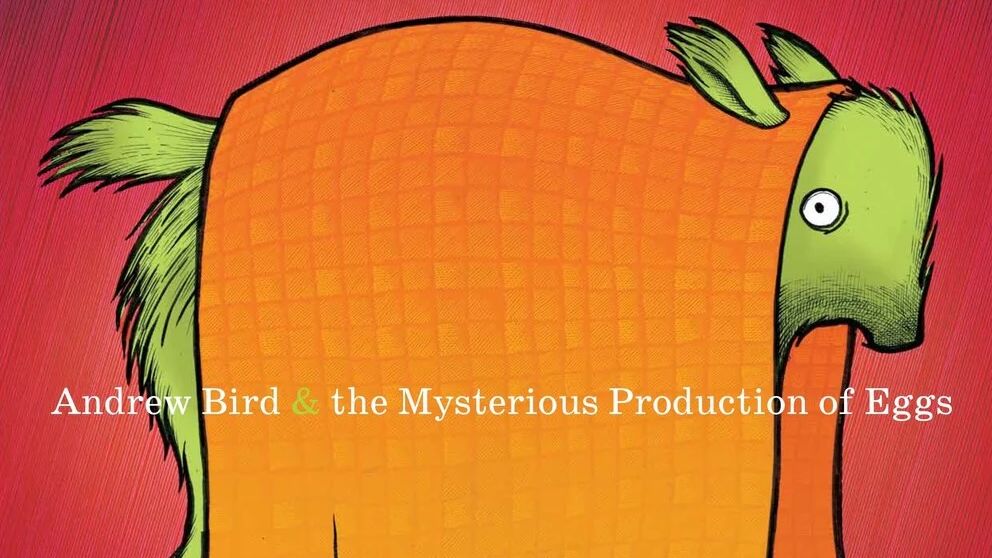
I had been considering the nature of nostalgia when I learned that Andrew Bird was rereleasing his 2005 album The Mysterious Production of Eggs, wondering whether it was possible to be nostalgic for something lost abruptly, or if nostalgia implied a loss so slow as to be imperceptible. Eggs wasn’t my introduction to Bird—2007’s Armchair Apocrypha was—but as soon as I found it, it stayed in my ears for years, its layered complexity eventually coming to represent a world of artistic confluence somewhere beyond my own small, stuck, teenaged one. Bird’s soft, earnest voice sometimes held a hush, as at the starts of “Sovay” and “The Happy Birthday Song,” and sometimes it soared, winding through violins and glockenspiels and his own startlingly clear whistling. On “The Naming of Things,” it took on an insistent strength, becoming almost a chant—You! You can’t be found when the bell rings! You weren’t there! That! Day! For the naming! Of things!—that could stand up to sludgy electric guitars. Songs branched wildly from their beginnings, followed no map as they veered in surprising directions, and occasionally seemed to end before they actually did (as with, fittingly, “Opposite Day”). When they did land somewhere familiar (“Skin Is, My,” “Tables and Chairs”), it was only after they had gone somewhere unexpected in the interim: a samba interlude, a cheerful anticipation of the apocalypse.
But after several years of popularity for Bird and similarly eclectic, literary-leaning artists—Beirut, The Decemberists, Sufjan Stevens—mainstream tastes seemed to move on. “Twee” became a derogatory catch-all, a net under which Bird and Eggs were caught. Those years seemed to get frozen into a moment in time. Bird’s sound evolved, moving in conceptual directions (as on 2015’s Echolocations: Canyon and 2017’s Echolocations: River), then closer to rock and toward the atmospheric and instrumental.
No score yet, be the first to add.
On those last two solo albums, some sonic motifs from Eggs show up again, and the re-release suggests that they are more than the unconscious expression of old habits. In an essay in the 52-page booklet that accompanies the vinyl box set, Bird reveals that the making of the record was formative for him as an artist and writes like it still feels close at hand. And over three LPs—the 20th-anniversary edition of Eggs, plus two discs of demos, rarities, and live recordings titled Andrew Bird & the Monstres That Walk and Which Came First?—these old, familiar songs sound more complex and layered than ever, embodying not just the moment out of which they came but the three-year-long process that it took to make them: Bird followed his first scrapped attempt to make Eggs at his Barn in Western Illinois with a second in Nashville, then with some noodling around at two studios in Chicago.
Recordings from these early sessions reflect both the originality of Bird’s vision and his struggle to find an artistic direction; an embryonic version of “Fake Palindromes” titled “Blood” could be mistaken for Cake or Spoon if it weren’t for Bird’s singular voice. “Zeros and Ones,” which would become the gentle, stretching “Masterfade,” surfaces samba rhythms so insistently percussive they make Bird sound like he’s mumbling through his vocal delivery. And an early recording of “The Happy Birthday Song” is gorgeous with swelling strings and big, resonant drums, but Bird’s croon comes across too plaintive and Nora O’Connor’s backing vocals too sad after the post-apocalyptic rah-rah of “Tables and Chairs.”