The Enduring Simplicity of Book of Love’s Debut
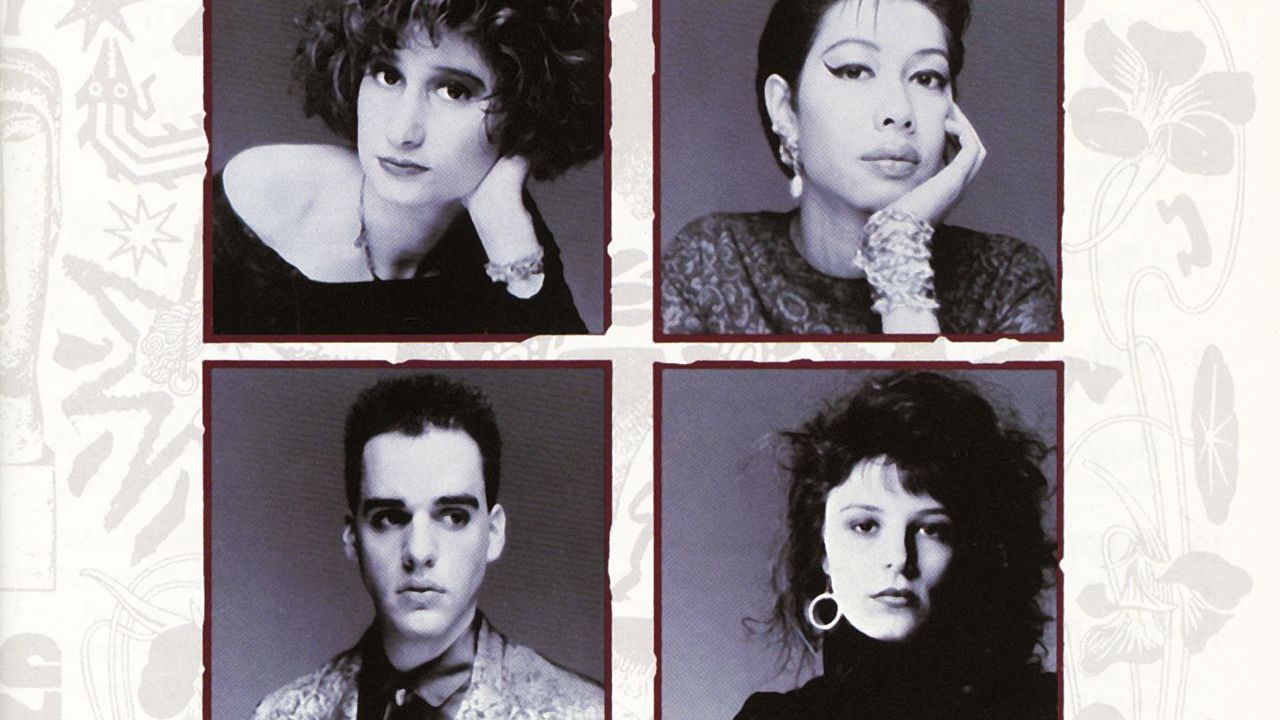
There was once a time, a very simple time, when you could start a new wave band with your art-school friends, record a few demos, play fewer than a dozen shows, and suddenly you’re on tour with Depeche Mode. Book of Love strutted into their brief moment of fame with the same laid-back attitude that colors their music. They were so naturally cool, so unabashedly themselves, that their brief moment as mid-1980s club superstars seemed like a happy accident. In an era when modern, up-and-coming bands had to dress louder, sound louder, and act louder than their peers to even have a chance at fame, Book of Love calmly asked, “Can’t it all be so simple?”
A Strategy of Simplicity
Their strategy of success via simplicity was impressive for many reasons, but mostly because the quartet had a ton to be loud about. Chief songwriters Ted and Susan Ottaviano are unrelated, despite growing up in the same Connecticut town, attending the same high school, and sharing the same last name. That they were also both queer art-school students might have been the least weird thing about them. Despite leaving their hometown to attend different institutes in Philadelphia and New York City, respectively, they managed to start the band long-distance, recruiting Susan’s classmate Jade Lee and Ted’s classmate Lauren Johnson, both multi-instrumentalists. That made them a three-quarters female and one-half queer new-wave band, an oddity even within their outwardly gender-fluid scene.
When they all finished school and moved to NYC, Book of Love managed to stand out from the “playground of misfits” and “eccentric characters” that populated the city’s club scene. But they didn’t stress their queerness, nor their gender; neither aspect was worn as fashion or, really, marketed in any sort of way. It never had to be acknowledged; “it was just understood,” Ted told The Advocate in 2001. They let their nature be natural; it subtly blossomed on “Boy,” the demo that earned them a deal with Sire and the Depeche Mode tour before their debut was even imagined.
The Minimalist Masterpiece
“Boy” was, in fact, just that good. A minimalist masterpiece released smack dab in the middle of the maximalist ’80s, a song about the struggles of gender nonconformity written by a queer man and performed by a queer woman, was a smash hit in clubs both gay and straight. It felt personally plucked out of a queer diary. There’s no specific narrative at play beyond the nonconforming angst. Gracefully open-ended, it’s just as readable by trans men, trans women, and any other denomination of nonconforming queerness. Scored only by drum machine, a single synth, chimes, and tubular bells, the song’s straightforward tale sounds dramatically magnificent in spite of its spareness.
Immensely personable, purposefully grand, but deceptively uncomplicated, “Boy” and its B-side—the group’s eponymous theme song and album closer, “Book of Love”—precisely capture the ethos that eventually drove their debut. Over the course of the tour and their subsequent club success, the band spent two years crafting the “pages from my book of love” that Susan—in her signature melodramatic monotone—sings about in the latter track: 12 charming art-school diary entries written with as much childlike whimsy as showy pompousness. Bridging the stylistic gap between the dominant schools of new wave, Book of Love presents queer and fem perspectives as spectacularly down to earth, natural as they are divine, and uncompromisingly innocent.
The Signature Sound
As songwriters, the Ottavianos usually only needed a metaphor, a single beautiful image, or a fun double entendre to serve as narrative backbones. The rest was filled in by Susan’s vampire-next-door vocal performance and wistful instrumentation. When the band stumbled upon a vast array of bells and chimes in a corner of Noise recording studio in Manhattan, Ted felt it was “a message from God” to make them the album’s signature instrument. All 12 songs incorporate bells or bell-like instruments into their sparse mixes. They’re the first thing you hear on album opener “Modigliani,” softly twinkling as they set the scene. They underscore the pretty verses of “White Lies” and bang away in the refrains of intense cuts like “Still Angry” and “Yellow Sky.” No matter how soft or hard, these bells bring a bittersweet undertone to Book of Love’s minimalist character, filling sparse mixes with soft reminders of the band’s innocent core.
The quartet lived and died by its spontaneity. Book of Love is the sound of musicians aware that the world knows nothing about them laying out their essence—their queerness, their femininity, their reserved artsyness—in the matter-of-fact terms that give their debut its unique character. The more sophisticated they subsequently grew—the more they felt the need to add to their toolkit, rather than simply work with what they already had—the less compelling their music became.