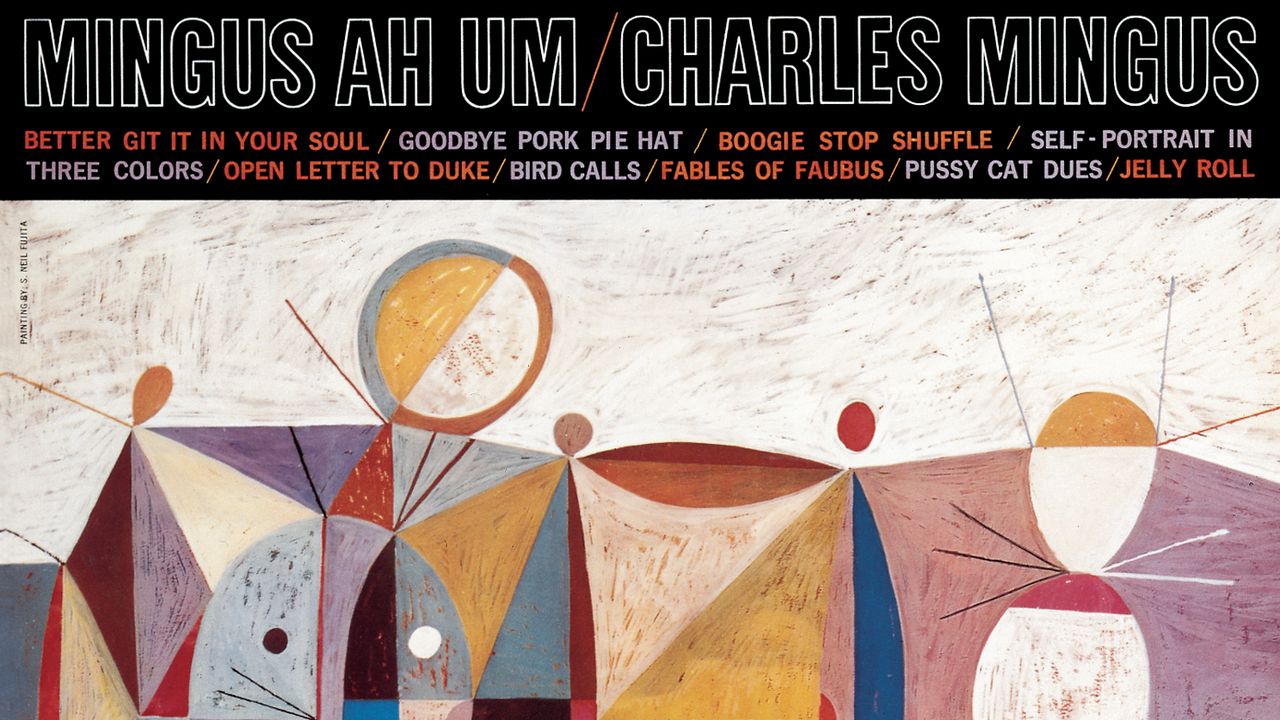
Mingus Ah Um just might be the most welcoming point of entry to the sprawling continent of jazz. Fierce in expression but controlled in form, the 1959 LP draws out a rootsy warmth from beneath the bebop that had consumed bandstands since World War II, forging a sound that feels at once confrontational, mischievous, and generous. Charles Mingus—bassist, composer, irascible iconoclast—had a large, rotating ensemble, a collective called the Jazz Workshop that he treated like one of the anti-mainstream theatrical troupes that had cropped up all over his home of New York City. Mingus and his faithful were about both process and product; the bandleader wanted to nurture a tradition, not rupture it.
On Mingus Ah Um, he reintroduced the ardence of the Black church to jazz, punctuating opener “Better Git It In Your Soul” with preacherly shouts. Meanwhile, his tactile upright stylings meet the clack of Dannie Richmond’s drums, fostering a clattering percussiveness borrowed from the blues. Mingus was a master of tone—as a player, sure, but more important as a composer. He knew how to capture the buoyancy and joy of a concert in the studio, how to coax sorrow or outrage from a brass section. His emotional eloquence pushed music toward the future.
“Fables of Faubus,” first released on Mingus Ah Um, bemoaned the status quo to rouse the would-be concerned from their slumber. The composition took aim at America’s legacy of oppression and, alongside Sonny Rollins’ 1958 record Freedom Suite, set the stage for political jazz as a force in the 1960s. When the recording came out, it was perhaps the genre’s most overt condemnation of Jim Crow this side of Billie Holiday’s rendition of “Strange Fruit.”
The song’s subject, Orval Faubus, was the governor of Arkansas and a featured bit player in America’s deranged commitment to anti-Black bigotry. Several years after the Supreme Court kickstarted integration with its 1954 decision in Brown Vs. Board of Education, the NAACP managed to enroll a small group of Black students in Little Rock’s Central High School. Faubus, the son of a Socialist, ended up capitulating to Confederate sympathies, as many segregationist Southern Democrats did, to appeal to his base. He deployed the state’s National Guard to greet his teenage constituents. Soldiers massed around Central, crossing rifles to prevent the Black students, who would soon be immortalized as the Little Rock Nine, from entering the grounds. An angry mob of white adults hurled slurs and spat on the high schoolers.
When these kids finally managed to attend classes, they were beaten and bullied by classmates. Fifteen-year-old Melba Pattillo Beals recalled having acid thrown at her eyes. (She ended up moving to California for the rest of high school after finishing her junior year at Central.) The house of another, Carlotta Walls, was bombed a month before her graduation, and the police subsequently tortured her father in an unsuccessful attempt to coerce a confession. Walls was the only member of the Little Rock Nine who graduated from Central—she later said that she believed that her chemistry teacher had helped other students build the explosive that targeted her. Faubus’ debacle, which garnered massive international notice, lasted for nearly three weeks, until President Eisenhower took control of the state’s National Guard and forced him to comply with federal law.