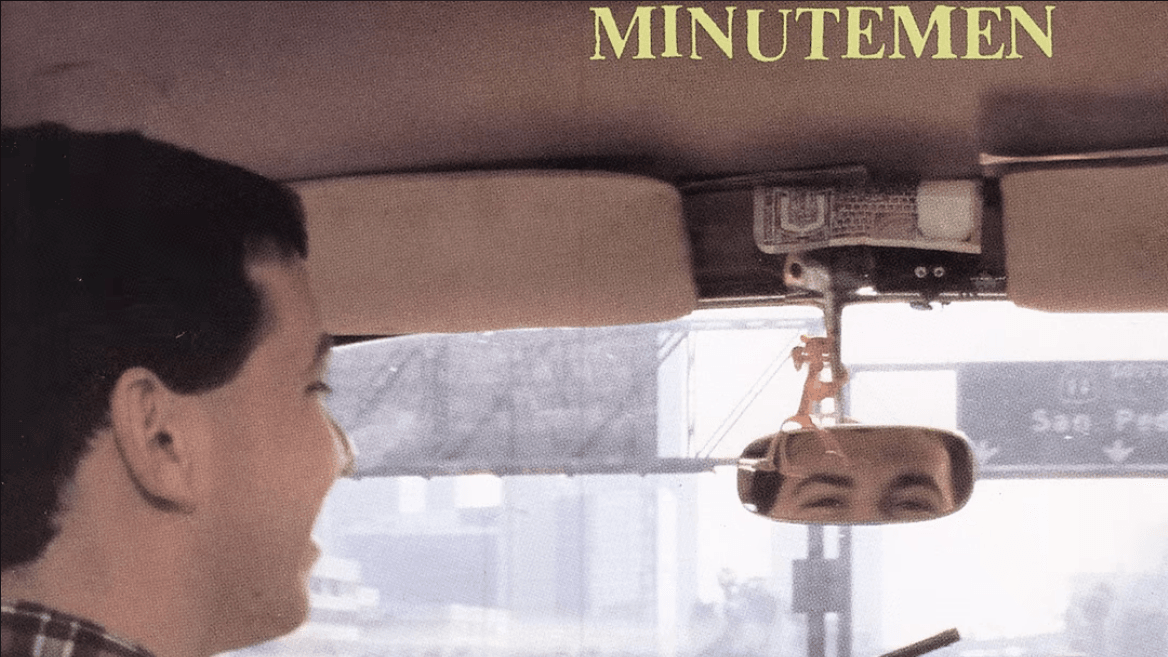
On a beach in Mexico, the Minutemen awoke to pain. They had spent the previous day swimming for hours along Rosarito Beach. Now, on the morning of Mexico’s 1982 election, the three punks were hungover and sunburnt, their newly shaved heads red and raw. Before decamping to a taqueria, they watched a woman make her way up and down the beach, collecting empty beer bottles to deposit for cash.
Struck by the display of poverty and desperation—all contrasted with scenes of beachside revelry—lead singer and guitarist D. Boon wrote “Corona,” a deceptively jaunty tune with a Norteño flavor. It’s the song that best epitomizes the trio’s spirit of freewheeling musical curiosity, cross-cultural fascination, and radical class solidarity, even if a younger generation associates it with guys on TV piercing their butt cheeks and shitting in display toilets.
Though they played with a funk-infused virtuosity that set them apart from the hardcore scene in which they moved, the Minutemen took pains to stress that they were just three regular dudes from San Pedro, a blue-collar outpost of Los Angeles. Childhood friends Boon and Mike Watt, along with their drummer, George Hurley, came from working-class families and held day jobs throughout the band’s existence. For Boon, a history buff liable to spout off about the English Civil War or U.S. involvement in El Salvador, the personal was always political; the singer worked at an auto parts store and channeled his loathing of a racist boss into the defiant “This Ain’t No Picnic,” one of many Minutemen songs instilled with a sense of egalitarian agitation. The group’s songs were short—usually under two minutes—but crammed with invectives against the ruling class (“The Only Minority”), mass marketing (“Shit From an Old Notebook”), and American imperialist greed (“Untitled Song for Latin America”), all filtered through an erudite wit.
Amid an era of Reagan-sanctioned greed, the Minutemen prized frugality, toured on the cheap, and “jammed econo.” They recorded their greatest work, 1984’s Double Nickels on the Dime, a 45-song opus of endless invention, for just $1,100. They conceived of art as a vehicle for working-class liberation; they believed in music by and for the common man. “One of our philosophies in the Minutemen has to do with, there should be more interaction with music and everyday people,” Boon said in a 1985 interview. “Cuz that’s what we are.” To that end, they dressed like regular joes, not rock royalty, and when Boon booked local bands at a San Pedro theater, he preferred shows to start early so working people could attend and still get up for their jobs in the morning.
Double Nickels on the Dime was a post-hardcore album in the literal sense: It was the album the Minutemen made after they’d mastered hardcore and set out to conquer every other genre, too. Across its four sides, and alongside the band’s trademark spiky punk paroxysms, Double Nickels offered jittery funk (“Theatre Is the Life of You”), spoken-word self-mythologizing (“History Lesson – Part II”), wacky Beefheart-ian diversions (“You Need the Glory”), tongue-in-cheek acoustic balladry (“Take 5, D”), and scrappy covers of Steely Dan and Creedence favorites. All three Minutemen contributed songwriting, and each member programmed a distinct side of the double-LP.