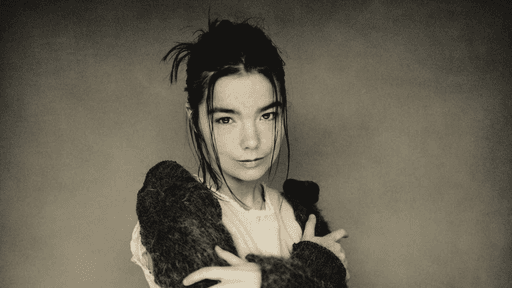
The story of “Human Behaviour” as we know it begins in 1993, when Björk swanned into London in a fluffy white mohair jacket. She was 27 and ready for adventure, so utterly international she could barely eat anything but curries, still high on her late-’80s supply of rave awakenings at all-nighters by DJs with names like Mixmaster Morris.
Björk saw through the idiot elements of British culture but decided to love it anyway, most of all its charismatic mavericks and prankster producers and the anything-goes musicians she took on tour under the banner of Immigrants United. Her creative soulmates were 808 State’s Graham Massey and Debut producer Nellee Hooper, whom she had found “too good taste, too expensive-sounding” for her industrial-techno soul, before he quelled her sophistiphobia by showing how rave and hip-hop beats might coexist with her voice in the plastic paradise of ’90s pop.
“Human Behaviour” was Björk’s formal debut, the salvo of an album so buccaneering and multivalent it could have been called Polygenic. Originally written in her sardonic teens, the song and its lyrics fit the perspective of an outsider arriving in a big city: A child (or in some tellings, an animal) utters conspiratorial warnings to a confidante, marvelling at the oddballs of adultkind. Though it charted modestly in the United Kingdom, the single spawned a landmark Underworld remix and various dub plates that reverberated through clubland, proving to the record industry that a deliriously characterful vocalist could make a post-rave dance record a hit.
The project occasioned a lift in vibe: Björk had spent the years prior serving with the Reykjavík intelligentsia in her old band the Sugarcubes, an accidentally successful cadre of anarchist poets convinced of their solemn duty to demystify stardom. This had been a fine idea, but Björk, through no fault of her own, was a born star and a natural mystic, immune to demystification. She was tired of Iceland, tired of poets, and tired of getting told off for playing Public Enemy on the tour bus.
With the Sugarcubes dissolved, Björk and Hooper’s Debut relished in cartwheeling beats and sensual delights. But its opener strikes a more ominous note. “Human Behaviour” builds on a sample from one of two soundtracks to 1970 movie The Adventurers—a racy American epic that was loathed by critics, audiences, and eventually its own director, Lewis Gilbert. Soon after its release, for reasons undocumented beyond having licence to do what the hell he wanted, Quincy Jones assembled the Ray Brown Orchestra to record a Blaxploitation redux. The original score had been composed by Antônio Carlos Jobim and, in a cosmic coincidence, arranged and conducted by Emuir Deodato, the future Brazilian disco legend whom Björk would enlist to contribute arrangements (and a perfect “Isobel” remix) to Post and Homogenic. From the Ray Brown Orchestra expansion came “Go Down Dying,” the song whose walloped timpani coaxes us into “Human Behaviour.”