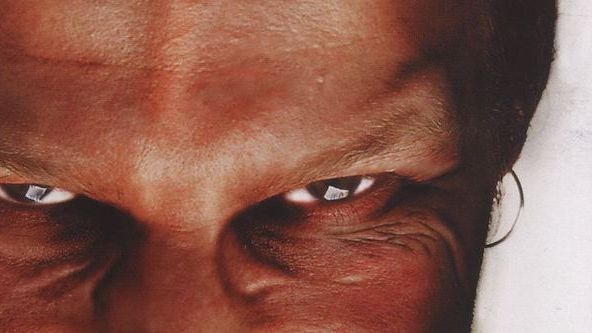
Richard D. James Album

When he was a young child, Richard D. James loved to crack open the family piano and detune the strings he found inside. He wasn’t after music, exactly. He didn’t really know what music was yet. His family had minimal interest in it, which fixes James’ childhood at a rather specific historical cusp, when people lukewarm on music would still have a piano around as a matter of course. Instead of piecing together tunes, he found himself captivated by the materiality and mechanics of sound itself. There in his Cornwall home was an intricate machine many times his size, designed to do nothing but produce note after note after note. A finger pressed a key and a tone reverberated. He could look inside the device and he could fiddle with it and he could change how it worked. A string loosened and a pitch bowed. Hammers tapped slackening fibers and instead of the pleasant overtones of a major scale, a nauseating cacophony swelled from the instrument’s wooden belly. His parents hardly encouraged these experiments, but neither did they forbid them. “I just got shoved in a corner of the house and was allowed to get on with it,” James said in 1994.

Soon the piano was not enough. James took to prying open electronic keyboards and bending their circuits when their built-in parameters didn’t satisfy his hunger for noise. Once he pressed against the limits of what prefab machines could give him, he started building his own synthesizers. He played around with tape recording and produced tracks compulsively; the earliest cuts on the first volume of his Selected Ambient Works he made in the mid ’80s, when he was still in his early teens. In time, music found him: Acid house, techno, trance, and jungle all filtered through as they coursed across the United Kingdom, Europe, and the globe. Subtler stuff from earlier in the century drifted in, too: ambient, musique concrete, avant-garde. Most of it chafed at him but he internalized its structures all the same. As his childhood rolled to a close, he started cutting tracks that took flight on local dancefloors. An early hit, “Didgeridoo,” was so named because that’s what ravers would chant when they clamored for him to play it. He found an audience in UK raves and detested performing for them. For James, bliss didn’t pour through the release of a riotous crowd but crept in total solitude as he pounded out track after track, late into the night—making, making, making.

Reader Score

No score yet, be the first to add.

0.0

If James bristled at the prospect of public exposure early in his career, he at least seemed to enjoy concocting his own mythologies. Reporters lapped up the stories of the prepared piano that the young James stumbled into by sheer intuition, never having caught wind of John Cage. They christened him the Mozart of 1990s techno, and James countered by saying he’d never heard Mozart in his life. He drove a tank around England, claimed to live in a bank vault, spent long hours playing city-sim computer games on acid, and weaned himself down to just two hours of sleep a night so he could have more time to work. He trained himself to lucid dream so he could write songs in his sleep. He adorned the covers of his albums with his own demonic grin. Then, since industry standards stipulated he had to perform live every now and then, he spilled the spectacle onto the stage. He dropped a turntable stylus onto a disc of sandpaper and let it spin for minutes on end, then encored with a kitchen mixer fed into a microphone. He invited bodybuilders and teddy bears to dance for him while he lay on his stomach, twiddling knobs, kicking his feet behind him like a child on his bedroom floor.

The Richard D. James Album, James’ fourth LP under his Aphex Twin moniker and third for electronic mainstay label Warp, arrived just as dance music started to rush the mainstream with growing clamor. Months after its release, singles from the Prodigy and the Chemical Brothers wound their way up the radio charts alongside alt-rock holdovers and glistening pop ballads. Entertainment Weekly wondered if electronica might be the next hot thing in the wake of grunge. But the radio favorites of 1997 had far more in common with James’ earlier rave-pleasers than anything on his self-titled (of sorts) record. By the time techno went pop, he had already moved on to stranger pastures.

In the mid ’90s, James was more interested in weaving together neoclassical finery with jungle precision than he was in competing among the broader dance landscape. People told him that his ambient works called back to Philip Glass, so he worked with the composer on the 1995 Donkey Rhubarb EP, which oscillated between slow orchestrations and blistering beats. The following year, the Richard D. James Album synthesized both universes into the same cloister. Recorded in the year leading up to its release, it’s arguably the first Aphex Twin album to crystallize around a legible thematic core, rather than a diffuse collection drawn from James’ extensive reservoirs.

James’ beats fractured into a newly bewildering density. If the 1995 LP …I Care Because You Do still clutched an umbilical cord leading to the dancefloor, the Richard D. James Album sliced itself loose from the conceit of bodies pulsing in space. You would need a new body to keep up with the fractals unspooling from the producer’s fingertips this time around. You would need whole new laws of physics.

At the same time, James’ melodies had never been so simple, so childlike, or so easy to grasp. Imagine a gaggle of nursery-school children playing around with every possible instrument within reach—jaw harp, slide whistle, tambourine, a Fisher Price keyboard—and you’ve got the album closer “Logan Rock Witch.” Now imagine an earthquake splitting the ground while the kids play on unperturbed and you’ve got the sick and skittering “Carn Marth.” The sweetly needling opener “4” blooms like a bouquet of flowers that are both fragrant and teeming with spiders: String chords sway beneath rudimentary and wiggling synth tones while James’ drum patterns blitz in and out of time. (James claimed he bought a cheap violin from a garage sale and recorded it flat on a table one note at a time, though the strings sound professionally played to me.) “Fingerbib,” meanwhile, scuttles like a playpen full of clockwork toys, its beats as sticky as rubber soles on tile beneath its delicately aerated leads. Its sheer loveliness almost completely undermines the menace of that rictus on the cover.

Almost: Childhood is both bliss and terror, and the Richard D. James Album takes care to wrap malevolence and innocence tightly into the same steel coil. With “To Cure a Weakling Child,” James integrates actual children’s voices (or voices treated to sound like children’s, who knows) into his roiling stew—an echo of Karlheinz Stockhausen’s pioneering “Gesang Der Jünglinge” (“Song of the Youths”), an electronic piece from the mid-1950s that wove the voices of boy sopranos into primordial synthesized tones. On “Weakling,” a simple singsong inventory of human body parts coasts over rubbery, skidding bass drums and percussive accents that mimic the rapid-fire clacking of tongues. The voices sound natural enough. The other mouth sounds mingle with the noise of machines until the line between the two gets blurry: a biomechanical squadron of impossible anatomies shivering at impossible speeds.

The album’s contrasts come into sharpest focus on the sumptuous “Girl/Boy Song (NLS Mix),” whose drums clatter at the pace of neurons linking in a brand new brain beneath plucked strings, bellowing bassoons, and glockenspiel chimes. A few months before the Richard D. James Album was released, “Girl/Boy Song” served as the leading track to an EP of the same name. On the cover was a photograph of a gravestone bearing the name “Richard James” and a single date: November 23, 1968.

When James was young, he would see that photograph displayed in his mother’s bedroom. It depicts the grave of his older brother, who shared his name and lived for only one day. “I really like the photo—probably more than any other picture I’ve ever seen,” James told The Independent in 1996. “I remember when I was about five, the crossover point between not knowing what it was and knowing what it was. I was a bit confused at first, then I got really into it: I used to show it to all my mates and say, ‘Look, a photo of my grave.’”

Like many of the tales in the Aphex Twin compendium, the story of his dead infant brother tends to mutate from telling to telling. To The Independent, he claimed that the reuse of the name Richard never troubled him. In an interview with MTV from the same year, he appeared more circumspect: “My mum named me after him after he died ’cause she didn’t want to acknowledge the fact that he died,” he said. “I always felt guilty that I nicked his identity.” The camera zooms in close on his face at this point in the interview, as if trying to glean a hint of emotion from the artist’s middle-distance stare. Is he choking up? Is he faking it? The photograph, at the very least, is real.

Little in the way of grief or guilt inflects the Richard D. James Album directly, though it does carry its share of melancholy in its wandering, wide-eyed melodies. What might cast the longest shadow is the moment James describes when he first became aware of what the photograph of his brother’s grave really meant. In early childhood, you don’t know what will happen to you. The world has yet to ossify into routine; reality remains at the consistency of putty. The intrusion of meaning into sensory experience is its own form of loss. Little by little, as you grow older, the world shapes itself around you. You come to recognize that you live among other people with their own frailties and compulsions, their own ways of coping with the terrible cruelties of circumstance. You’re raised by parents who harbor grief you can’t fathom, and you learn to creep around the places where it presses in on your burgeoning self. You figure out where you shouldn’t step. You make do with the space that’s left to you.

Aphex Twin’s music first came to me through the films of Chris Cunningham and David Firth. The former worked with James directly on iconic music videos like 1997’s “Come to Daddy”; the latter made unauthorized use of the producer’s music to soundtrack the eerie flash animations he published online in the 2000s. Both filmmakers articulate worlds where something has gone profoundly wrong. The films peer out into desolate post-industrial landscapes. The characters that populate these worlds are both innocent and monstrous: small children wearing James’ grinning, bearded face in Cunningham’s “Come to Daddy,” a bewildered, lonely humanoid craving the feeling of rust on his skin in Firth’s “Salad Fingers.” They have fallen into abjection and they do not know how or why. There is no one around who can tell them. Still, they play. They remember how to play.

With the Richard D. James Album, Aphex Twin applied his astonishing adult dexterity to the widening wonder, dread, and curiosity that attend early childhood. His breakbeat lullabies threatened to upend sequential time. What if you could hear, see, smell, and feel your surroundings for the first time but with all the neurological scaffolding you’ve built through years and decades of repetition? A better question: What if those first awakenings don’t get lost to time, but are only the tightest coils inside a chitinous spiral of experience, which keeps on widening, and never stops?