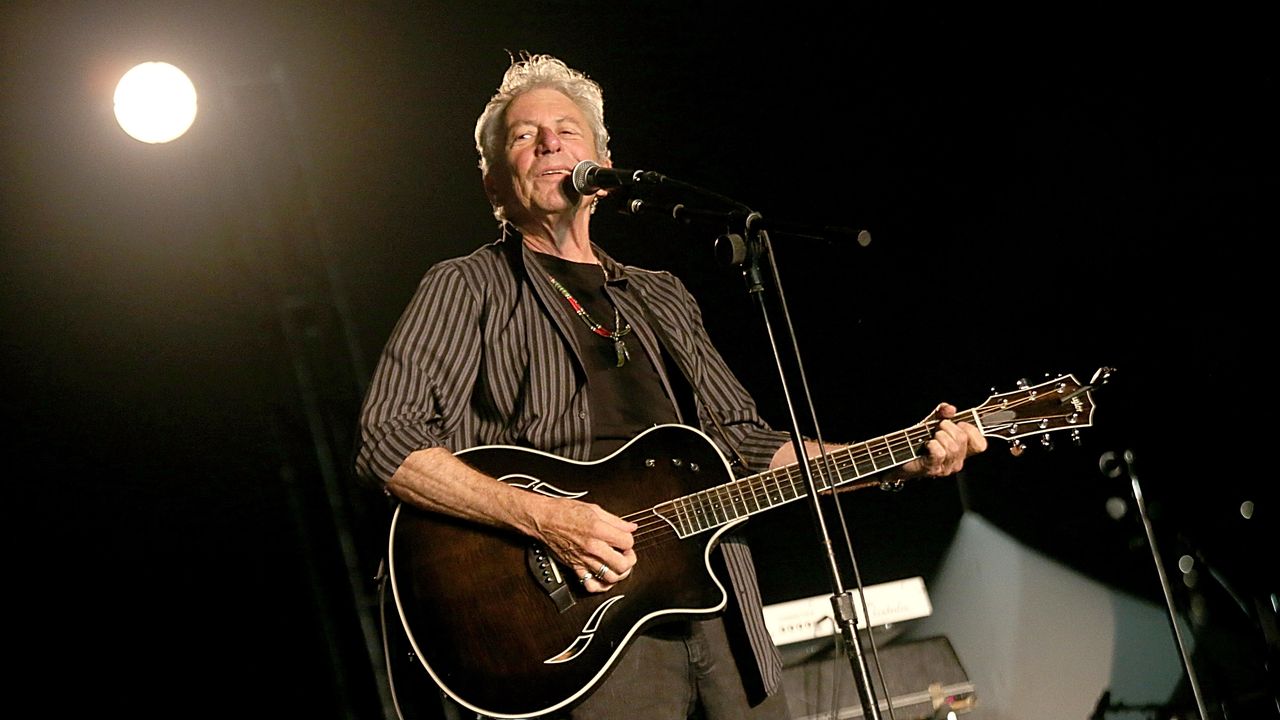
Joe Ely, the Grammy-winning singer-songwriter who helped spearhead Texas’ progressive country movement in the 1970s, has died, his representative confirmed to Rolling Stone. Ely died from complications of Lewy Body Dementia, Parkinson’s, and pneumonia at his home in Taos, New Mexico. He was 78.
As is true of the most revered country icons, Ely lived a long and storied life that was ripe with material for songs. Although his music career technically began with the Flatlanders, the country band he formed with fellow Texans Jimmie Dale Gilmore and Butch Hancock in 1972, Ely really found his audience with his self-titled solo debut in 1977; with each passing year, Ely’s natural lyricism and ear for rock hooks helped push a new type of progressive country to the forefront of the Texas community. In the decades that followed, he went on to collaborate with the Clash, Bruce Springsteen, Uncle Tupelo, the Chieftans, and many others.
Born in Amarillo, Texas, on February 9, 1947, Ely and his family relocated to Lubbock where he spent his teenage years attending high school and playing guitar. In his 20s, Ely crossed paths with Gilmore and Hancock and they decided to form a band that would utilize their interests in country, folk, and storytelling. The Flatlanders only released one album, 1973’s All American Music, before disbanding that same year. However, once the three musicians found independent success as solo artists, they regrouped to record a handful of albums together and perform live as a band once again, eventually earning their place in the Austin Music Awards Hall of Fame.
When he launched his solo career, Ely settled into country music from an openminded and openhearted place, churning out songs that welcomed everyone into the fold regardless of how familiar they were with the genre. That accessible approach earned him multiple charting albums, with 1981’s Musta Notta Gotta Lotta hitting No. 135 on the Billboard 200 and No. 12 on the Top Country Albums chart. Later on, 1998’s Twistin’ in the Wind reached No. 55, 2003’s Streets of Sin peaked at No. 51, and his 2011 record Satisfied at Last claimed spot No. 46 on the Top Country Albums chart. Yet for all of his beloved originals, one of Ely’s biggest songs was a cover of Robert Early Keen’s “The Road Goes on Forever,” which he tacked onto his 1992 album Love and Danger. His final album, Love and Freedom, came out in February 2025.
But for most artists, especially those rooted in the rock world, the country star came to their attention not by his records, but through his opening gigs. The Rolling Stones brought him out on several dates in 1981, Tom Petty and the Heartbreakers tapped him for over a dozen shows, and a number of other classic-rock acts—Stevie Nicks, the Kinks, the Pretenders—asked Ely to open their concerts as well, introducing him to thousands of new fans on a shared stage – and bridging the gap between country and rock in the process.
Before any of those tours, though, was Ely’s famous opportunity to open for the Clash in 1979. Ely and his band crossed paths with the Clash during their own show in London months earlier and kept in touch; that easygoing rapport the two acts established led the punk rockers to invite Ely to play with them in the United States and join them on their U.K. leg in 1980 in support of London Calling. Just a few years later, the Clash brought Ely into the studio to sing backup vocals on “Should I Stay or Should I Go?” as well.
In 1998, Ely joined forces with Freddy Fender, Flaco Jiménez, Los Lobos’ David Hidalgo and Cesar Rosas, Rick Trevino, and Ruben Ramos to form the supergroup Los Super Seven. Together, they put a Latin-rock spin on Chicano and Texan rock, funneling their ideas into a self-titled album that same year. In 1999, the band took home the Grammy Award for Best Mexican/Mexican-American Album thanks to that self-titled LP.
Ely was always happy to collaborate with other artists, whether it be accepting an invitation to contribute harmonica to Terry Allen’s records and guitar to Uncle Tupelo’s final album, or inviting Bruce Springsteen to sing on his own tracks. When Ely tapped Springsteen to join him on the song “Odds of the Blues” for his 2024 album Driven to Drive, the country artist reminisced on what an effortless friendship the two musicians had developed over the decades, calling them “long lost friends for a long time.”
Much of Ely’s much focused on escapades, perseverance, and abiding by the truth. “I had teachers tell me I wouldn’t make it to 21 when I was going to high school, so I beat the odds, you know?” Ely told Lone Star Music Magazine in 2011. “I’ve traveled millions of miles, zigging and zagging in every kind of vehicle known to man, trying to get from one place to another to create some more music. And there’s been a lot of times where, you know, I’ve had some dilemmas. There was one tour that we did around Europe, in ’86 or ’87, where everywhere we went, things were just snapping at our heels. Like, we got off a ferry, and the next day that ferry sunk. We checked into the King’s Hotel, and the next day the hotel burned down. The whole tour was like that! Everywhere we went, we just heard these stories of, you know, ‘The bridge fell down yesterday! The train crashed!’ Every vehicle that we were on. Our English roadies tried to run a roadblock at the border in Italy, and we could have been incarcerated for years.”
“But then sometimes, everything is just a breeze,” he continued. “Everything is just so easy: ‘Ah, yeah… we made that light, we found our hotel, we missed the blizzard, the tornadoes came three days later…’ So in the end you kind of add up all the life experiences that you’ve had, from threats to just running into weird coincidences constantly, and then you think, ‘Wow, I made it through all that. So I can take a breath of air, and then go from there.’ It’s just a little pause, and then you’re back in it.”